Korea Recycling Guide: Trash Sorting Rules, Collection Days, and Penalties
Recycling in Korea can feel overwhelming at first. This beginner's guide explains general waste, recyclables, and food waste so foreign residents can sort with confidence.
Korea Recycling: The Strict System
Korea recycling is taken seriously. Korea recycling rules are strict but manageable. Korea has one of the world’s most rigorous recycling programs, and mastering Korea recycling keeps you out of trouble. For foreigners, the complexity can be overwhelming—wrong disposal can result in fines and neighbor complaints. This guide explains exactly how to sort. See also our apartment living guide your trash, when to put it out, and how to avoid common mistakes.
Korea Recycling: Waste Categories
The Four Main Categories
| Category | Korean | Disposal Method |
|---|---|---|
| General waste | 일반 쓰레기 | Designated paid bags |
| Food waste | 음식물 쓰레기 | Separate container/bag |
| Recyclables | 재활용 | Sorted by material, free |
| Large items | 대형 폐기물 | Paid stickers, scheduled pickup |
Korea Recycling: General Waste
Designated Trash Bags
You must use government-issued bags:
- Called “종량제 봉투” (jongryangje bongtu)
- Sold at convenience stores, supermarkets
- Different colors/designs by district
- Using wrong bag = fine up to ₩1,000,000
Bag prices (vary by region):
| Size | Price (Seoul, approx.) |
|---|---|
| 5L | ₩150-200 |
| 10L | ₩300-400 |
| 20L | ₩500-700 |
| 50L | ₩1,000-1,500 |
Note: Each city/district has its own bags. Seoul bags won’t work in Busan.
What Goes in General Waste
- Dirty paper or paper products (tissues, receipts)
- Broken glass (wrapped safely)
- Ceramics and pottery
- Rubber items
- Leather
- Soiled plastic that can’t be cleaned
- Composite materials
Korea Recycling: Food Waste
Why It’s Separate
Korea recycles nearly 95% of food waste into animal feed and compost. This requires keeping food waste separate and relatively clean.
Disposal Methods
Apartment buildings:
- Dedicated food waste bins in garbage area
- May use RFID system (scan card, charged by weight)
- Some buildings provide compostable bags
Houses/villas:
- Separate food waste bags (different from general waste)
- Smaller containers for curbside pickup
- Put out on designated days only
What IS Food Waste
- Fruit and vegetable scraps
- Rice and grains
- Bread
- Meat (small amounts)
- Fish (soft parts)
- Egg contents (not shells)
- Spoiled food
What is NOT Food Waste
Common mistakes—these go in general waste:
- Bones (chicken, pork, beef)
- Seafood shells (crab, shellfish)
- Egg shells
- Fruit pits and hard seeds (peach, avocado)
- Corn cobs
- Onion/garlic skins
- Tea bags and coffee grounds (in filter)
- Nut shells
- Spicy peppers (can affect animal feed)
Rule of thumb: If an animal can’t eat it, it’s not food waste.
Korea Recycling: Recyclables
Paper (종이류)
What to recycle:
- Newspapers
- Cardboard (flattened)
- Paper bags
- Books and magazines
- Office paper
- Milk cartons (washed, dried, flattened)
NOT recyclable:
- Receipts (thermal paper)
- Tissues and paper towels
- Wax-coated paper
- Paper with food residue
- Stickers and labels
Plastic (플라스틱)
What to recycle:
- PET bottles (remove cap and label)
- Plastic containers (clean)
- Plastic bags (separate from other plastics)
- Styrofoam (clean, separate)
Preparation:
- Remove labels and caps when possible
- Rinse to remove food residue
- Flatten to save space
- Some areas separate by plastic type
NOT recyclable:
- Dirty plastics with food residue
- Plastic mixed with other materials
- Toys and complex plastic items
Glass (유리)
What to recycle:
- Glass bottles (soju, beer, wine)
- Food jars (cleaned)
Preparation:
- Rinse thoroughly
- Remove caps (recycle separately)
- Remove labels when possible
NOT recyclable (general waste):
- Broken glass (wrap in newspaper, label “깨진 유리”)
- Mirrors
- Light bulbs
- Ceramics
Cans (캔류)
What to recycle:
- Aluminum cans (beer, soda)
- Steel cans (food cans)
- Aerosol cans (empty)
Preparation:
- Rinse clean
- Crush if possible
- Remove plastic labels when easy
Vinyl/Plastic Film (비닐)
What to recycle:
- Shopping bags
- Packaging wrap
- Plastic film
Preparation:
- Collect together
- Tie in bundle or bag together
- Must be clean
Korea Recycling: Special Items
Large Items (대형 폐기물)
What counts:
- Furniture (bed, sofa, desk, chair)
- Appliances (TV, refrigerator, washing machine)
- Mattresses
- Exercise equipment

How to dispose:
- Visit district office website or app
- Apply for pickup (online or by phone)
- Pay fee (₩3,000-50,000+ depending on item)
- Receive sticker (print or pickup from office)
- Attach sticker to item
- Place outside on designated day
Alternatively:
- Sell or give away on secondhand apps (당근마켓)
- Donation centers for usable items
Electronics (전자제품)
Small electronics:
- Phones, tablets, small appliances
- Drop off at electronics stores (free take-back programs)
- Collection boxes in some apartment buildings
Large electronics:
- Free pickup for major appliances when buying new one
- Otherwise treat as large waste
Batteries (건전지)
- Separate collection boxes at supermarkets, community centers
- Never put in regular trash
- Apartment buildings often have collection points
Fluorescent Bulbs (형광등)
- Separate from regular glass
- Collection points at apartment buildings, community centers
- Handle carefully—contains mercury
Clothing and Textiles (의류)
- Donation bins (의류수거함) in most neighborhoods
- Should be clean and wearable
- Damaged textiles go in general waste
Medicine (의약품)
- Return to pharmacies
- Never put in regular trash or flush
Korea Recycling: Collection Schedule
When to Put Out Trash
Typical schedule:
- General waste: 2-3 times per week
- Food waste: Daily or every other day
- Recyclables: Designated days (usually 1-2 times per week)
Time:
- Usually evening (after 7 PM) or early morning
- Must be out before collection time (typically early morning)
- Don’t leave out too early or for extended periods
Where:
- Designated collection points
- Apartment buildings: designated garbage area
- Houses: curbside at designated spot
Finding Your Schedule
How to check:
- Ask building manager or neighbors
- District office website
- Look for posted signs in garbage area
- Some apps show local collection schedule
Korea Recycling: Apartment vs House
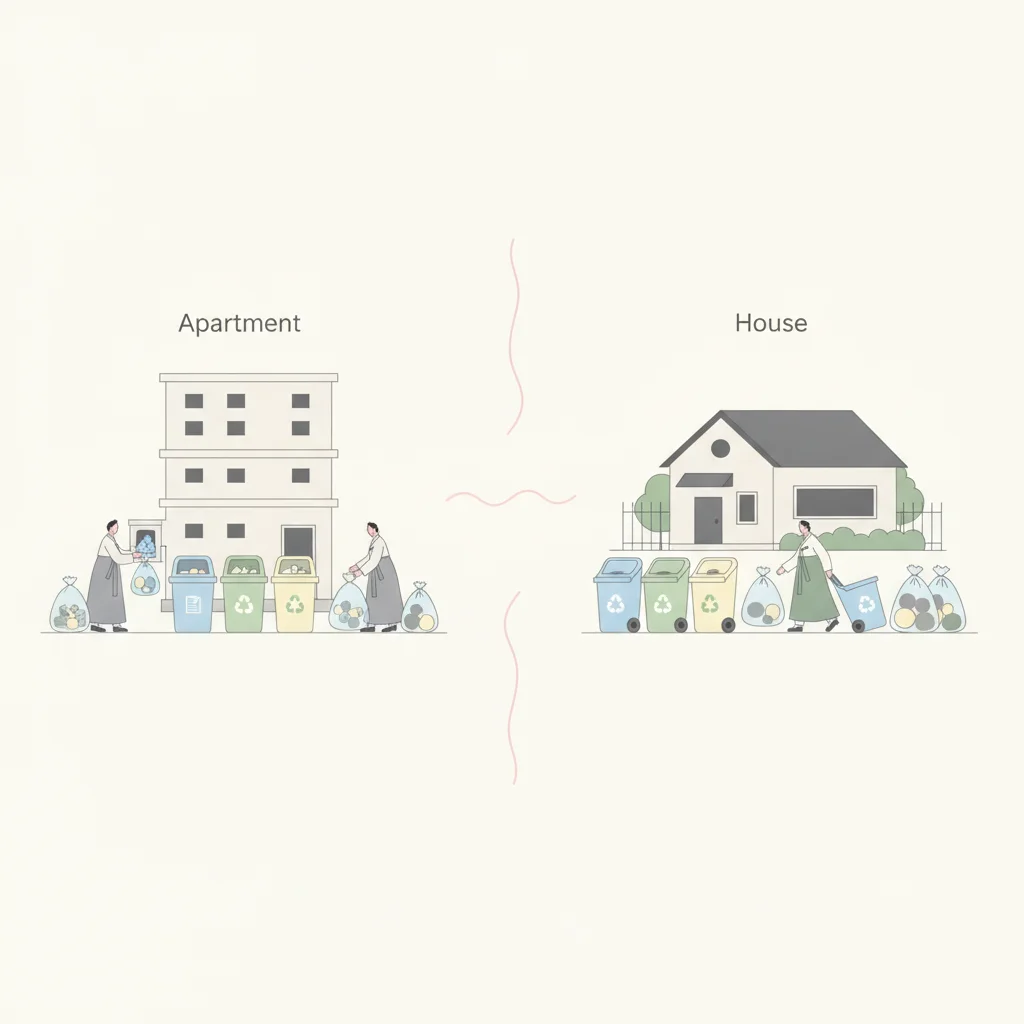
Apartments (아파트)
Usually have:
- Designated garbage room or area
- Separate bins for each recyclable type
- RFID food waste system (charged by weight)
- Building-specific rules
Advantages:
- Can dispose any time (usually)
- Recycling bins clearly labeled
- Less strict supervision
Houses and Villas (주택/빌라)
Characteristics:
- Curbside pickup
- Specific pickup days and times
- Must use correct neighborhood bags
- Neighbors watch—improper disposal noticed
Korea Recycling: Fines and Enforcement
Common Violations
| Violation | Fine |
|---|---|
| Not using designated bag | Up to ₩1,000,000 |
| Disposing at wrong time | Up to ₩500,000 |
| Not separating recyclables | Up to ₩500,000 |
| Food waste mixed with general | Up to ₩500,000 |
| Illegal dumping | Up to ₩1,000,000 |
Enforcement:
- CCTV in many disposal areas
- Inspectors can open and check bags
- Neighbors often report violations
- Fines are actually enforced
Korea Recycling: Tips for Foreigners
Getting Started
- Ask your landlord for recycling guidelines
- Observe how neighbors sort trash
- Take photos of the recycling area with labeled bins
- Start simple—master basics before details
Useful Korean Words
| Korean | Romanization | Meaning |
|---|---|---|
| 쓰레기 | sseuregi | Trash/garbage |
| 재활용 | jaehwalyong | Recycling |
| 음식물 | eumsikkmul | Food waste |
| 종량제봉투 | jongryangje bongtu | Designated trash bag |
| 분리수거 | bulli suge | Waste separation |
| 대형폐기물 | daehyeong pyegimul | Large waste |
When in Doubt
- If unsure, put it in general waste (safest option)
- Clean items before recycling
- Watch what Korean neighbors do
- Ask building manager for guidance
Korea’s recycling system requires effort to learn, but it becomes routine quickly. The environmental benefits are real—Korea recycles more than most countries—and participating properly shows respect for your community. Start by mastering the basics, and refine your sorting as you learn local specifics.
Learn about waste management in Korea at Waste management in South Korea on Wikipedia.
Related Guides
- Korea Apartment Living Guide
- Korea Housing Guide
- Korean Neighborhoods Guide
- Everyday Life in Korea
- Shopping in Korea Guide
Step-by-Step: How to Sort and Dispose of Household Waste
- Get the right bags first. Every district (구) sells its own official pay-as-you-throw (종량제) bags at any convenience store or supermarket in that district. A bag bought in Gangnam-gu will not be accepted in Mapo-gu — always buy locally.
- Split waste into three streams before you leave your unit: general waste (종량제 bag), food waste (별도 음식물쓰레기 bag or bin, charged separately), and recyclables (no bag needed, sorted by material at the collection point).
- Rinse recyclables — bottles, cans, and containers with food residue are often rejected by collection staff or your building’s recycling room.
- Separate by material at the bin, not by putting everything in one recycling bag: paper, plastic (PET separate from other plastics), glass, cans/metal, and styrofoam usually have distinct bins even within the same recycling room.
- Take large items (furniture, appliances) to your 구청 office or apply online for a bulky-waste sticker (대형폐기물) — you cannot simply leave these next to the general bins.
- Check your building’s collection days. Apartments often allow daily drop-off in a shared recycling room; standalone houses (단독주택) usually follow fixed collection days and must leave bags curbside only on those days.
| 쓰레기 종류 | 배출 방법 | 어디에 버리나 | 흔한 실수 |
|---|---|---|---|
| 일반쓰레기 (General waste) | 구별 종량제 봉투 구매 후 배출 | 지정 배출 장소/수거함 | 다른 구에서 산 봉투 사용 |
| 음식물쓰레기 (Food waste) | 별도 음식물 전용 봉투/칩 사용 | 음식물 전용 수거함 | 뼈·껍질 등 비음식물 혼합 |
| 재활용 (Recyclables) | 봉투 불필요, 재질별 분리 | 재활용 분리수거함 | 세척 안 한 상태로 배출 |
| 대형폐기물 (Bulky waste) | 구청 방문/온라인 신청 후 스티커 부착 | 지정 장소, 스티커 부착 필수 | 스티커 없이 무단 배출 |
FAQ
Do I need to buy special garbage bags in Korea?
Yes, for general and food waste. Recyclables don’t need a bag but must be sorted by material.
What happens if I sort my waste incorrectly?
Collection staff or your building manager may leave it uncollected with a warning sticker, and district offices can issue fines (up to roughly ₩1,000,000 for repeated or large-scale violations under local ordinances).
How do I dispose of large items like furniture?
Apply for a bulky-waste sticker (대형폐기물 스티커) through your district office website or app, pay the fee, attach the sticker, and leave the item on the designated collection day.
Is recycling different in Seoul vs. other cities?
The three-stream system (general/food/recyclable) is nationwide, but bag colors, prices, and collection schedules are set per district, so rules differ even between neighboring districts.
What if I live in a house instead of an apartment?
Houses (단독주택) don’t have a shared recycling room, so you must follow fixed curbside collection days and times set by your district — leaving bags out early is one of the most common complaints from neighbors.
Sources checked 2026-08-14: 환경부 자원순환 정보, district-level household waste guidance pages.