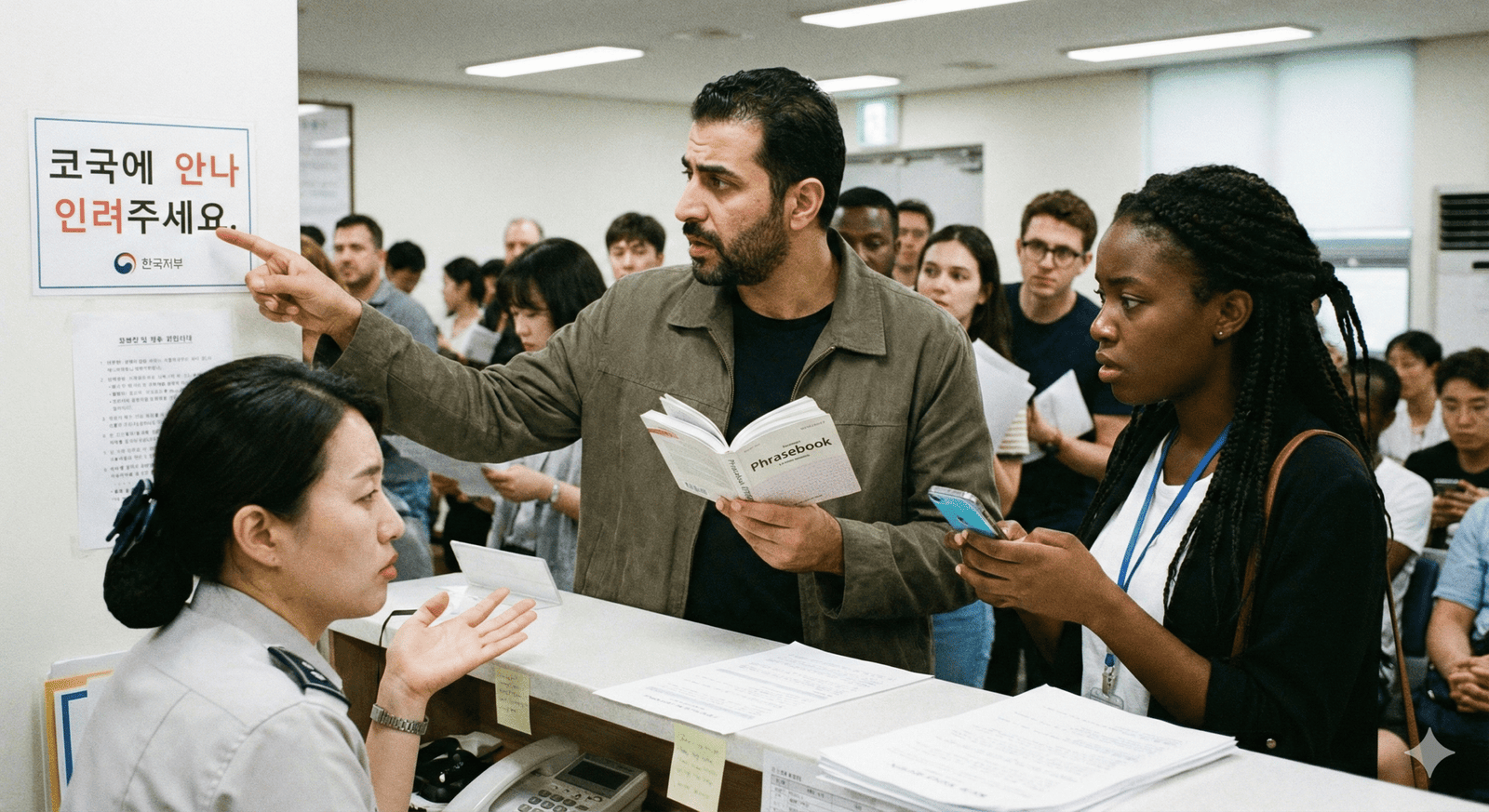
You’d think immigration offices — the places that literally handle foreigners — would be fluent in English. They’re not. Not even close.
The first time I went to extend my visa I expected bilingual staff. Maybe a few English forms. Instead I got a maze of Korean-only paperwork. A polite but wordless clerk. And the growing suspicion that I was in the wrong universe. Reality check.
It’s not that Koreans don’t want to help. It’s that immigration offices were built to handle volume not conversation. And with foreigners flooding in from dozens of countries English isn’t the universal fix we assume it is. If you’re new here knowing how to navigate that linguistic wall can save you hours of frustration. And a few minor existential crises.
Why English Isn’t Common at Immigration Offices
Let’s start with the unromantic truth. Korea doesn’t run on English. It runs on efficiency, paperwork, and systems that assume everyone already knows what to do. Immigration officers aren’t customer service reps. They’re civil servants processing hundreds of cases daily. Different job entirely.
Here’s the breakdown:
Not All Foreigners Speak English. Immigration offices deal with people from Vietnam, Nepal, Uzbekistan, the Philippines, Russia, and dozens of other countries. English might help thirty percent of visitors. Not enough to make it the default. Math doesn’t work.
Language Skills Aren’t a Hiring Priority. Officers are selected for their legal knowledge not their TOEIC score. A few speak basic English. But full fluency isn’t required for the job. Different skill set.
Policy Over Personality. Korean bureaucracy prioritizes standardized rules over improvisation. English communication introduces risk. Misunderstandings, liability, inconsistency. Korean-only systems avoid that. Risk management basically.
HiKorea Exists. The government assumes foreigners can use the HiKorea.go.kr website which offers limited English guidance. Emphasis on limited. To them that’s enough language support. Low bar honestly.
A friend once joked “The only English word immigration knows is ‘Next!'”
He wasn’t wrong.
The Bureaucratic Logic: It’s Not You, It’s the System
Korea’s immigration process is designed to be impersonal. Everything is about documentation not dialogue. If your papers are in order you’re golden. If not no amount of explaining will help. Simple equation.
Officers rely on checklists. They aren’t encouraged to interpret your situation creatively. That’s why one officer might reject your form while another — same office same desk — accepts it the next week. Consistency comes from paperwork not language. System quirk.
Ironically this rigidity is also what makes the system work. You don’t need favors or small talk. You just need the right stamp in the right box. It’s maddening but fair in its own robotic way. Cold efficiency.
Still when you’re standing there trying to mime “I lost my ARC and need a reissue” it doesn’t feel fair at all. Feels absurd actually.
Real Talk: How to Survive a Non-English Immigration Visit
Let’s get practical. Here’s how to avoid imploding at the counter.
Bring Every Document You’ve Ever Owned. Korean immigration loves physical proof. Even if the website doesn’t list it bring it. Passport, ARC, employment letter, housing contract, photo, school certificate, visa copy. You’ll look like an over-prepared nerd. But it pays off. Always.
Use Google Translate (Camera Mode). It’s your best friend. Take photos of forms or signs. The app translates them instantly. Papago by Naver works even better for Korean text. Technology saves lives.
Write Things Down in Korean. Print your purpose clearly. Show it to the officer. No embarrassment necessary. Visual communication works.
Use Polite Magic Words. Learn “excuse me,” “thank you,” and “sorry” in Korean. Politeness buys patience. Cultural currency.
Visit a “Global Center.” Cities like Seoul, Busan, and Daegu have immigration branches or help desks labeled “Global.” Staff there usually speak conversational English. Trained for foreigner-heavy inquiries. Your safe zone.
Go Early. Lines start forming before opening hours. Morning officers tend to be calmer. By three p.m. the whole building smells like anxiety. Palpable tension.
Avoid Mondays and Fridays. Mondays are backlog chaos. Fridays are “just-survive-until-weekend” mode. Tuesday or Wednesday mornings are ideal. Strategic timing matters.
If You’re Stuck Call 1345 (Immigration Hotline). They have English-speaking operators who can translate over the phone while you’re at the counter. It’s awkward but effective. Emergency lifeline.
The Emotional Part No One Warns You About
There’s a particular helplessness that hits when you can’t explain something as basic as “I already submitted that form online.” You feel invisible. Infantilized. Frustrated.
Even if you’re fluent in other languages Korean bureaucracy will humble you. Universal experience.
Seen foreigners cry quietly in those plastic chairs. Also seen officers suddenly soften. Type things silently. And hand over a solved problem without a word. It’s not malice. It’s just process. Impersonal system.
The key is emotional endurance. Bring water. Headphones. A book. Treat it like camping. With fluorescent lighting and paperwork. Survival mode activated.
Understanding the Cultural Side
Korea values context and respect more than verbal fluency. You don’t need perfect Korean to communicate. You need the right tone. Be patient. Keep your voice calm. And bow slightly even if you’re frustrated. Loud complaints or sarcasm won’t get you far. Cultural rules apply.
One Korean friend explained it perfectly. “When you show effort they show kindness.” It’s a quiet social exchange. Your humility for their flexibility. Unspoken contract.
Also never underestimate the power of nonverbal clarity. A printed checklist in Korean will do more for you than fluent English ever could. Visual proof wins.
If the immigration office makes you want to cry into your paperwork you’re not alone. There are organizations designed to help foreigners with bureaucracy. Some free some low-cost:
Seoul Global Center (sgc.seoul.go.kr) – Free legal and visa help in English, Chinese, and more.
Korea Immigration Service Foundation – Works with local immigration offices to guide expats.
Local City Halls – Many have “Foreign Resident Help Desks.” The English level varies. But they’ll point you the right way.
These places can even call immigration on your behalf. Clarify document requirements. It’s like having a Korean friend without having to bribe them with coffee. Support network exists.
Digital Shortcuts (Because Paperwork Is Eternal)
Immigration offices love in-person visits. But some steps can be done online:
HiKorea.go.kr – For appointments, visa extensions, document downloads. The English version is clunky but usable. Better than nothing.
1345 Chatbot – You can message immigration officers directly for basic questions. Korean required though.
Naver Café groups – Expats in Korea post real-time updates about immigration experiences. Search “Visa Korea” or “HiKorea help.” Crowdsourced wisdom.
Just remember. What worked for one foreigner last month might not work for you this week. Rules shift quietly without warning. Constantly evolving.
In the End: Don’t Take It Personally
If you walk out of immigration feeling exhausted confused and mildly existential congratulations. You’ve just had the authentic Korean bureaucratic experience. Everyone Korean or foreign suffers equally there. Universal pain.
The lack of English isn’t neglect. It’s a symptom of a country still adjusting to becoming multicultural. Twenty years ago Korea barely had a visible foreign population. Now there are millions. And the system’s catching up. Slowly, awkwardly, but steadily. Growing pains.
So next time you’re stuck at immigration with your phone camera translating signs and your patience wearing thin remember. The officer probably wants to go home just as much as you do. Shared humanity.
And somehow despite the chaos most of us make it through. Resilience tested and proven.
FAQ
Why don’t Korean immigration officers speak English? Because English isn’t required for their job. And most visitors aren’t native English speakers. Simple logic.
Can I bring a translator with me? Yes totally fine. Just let the officer know at the counter. They’ll appreciate it.
Do I need to make an appointment? For most services yes. Book through HiKorea.go.kr to avoid long waits. Time saver.
Is there a special office for foreigners? Some cities have “Global Centers” or “Foreign Resident Support Offices.” Find them.
What’s the phone number for English help? Call 1345. Korea Immigration Service Hotline. Press 0 for English. Emergency resource.
Can I use Google Translate at the counter? Absolutely. Most officers are patient if you use translation apps. They get it.
What if the officer is rude or dismissive? Stay calm. Ask politely for another officer. Or contact 1345 after leaving. Options exist.
Weird question — can I bribe them with snacks? Please don’t. This isn’t Southeast Asia. Just bring paperwork and patience. Different culture entirely.