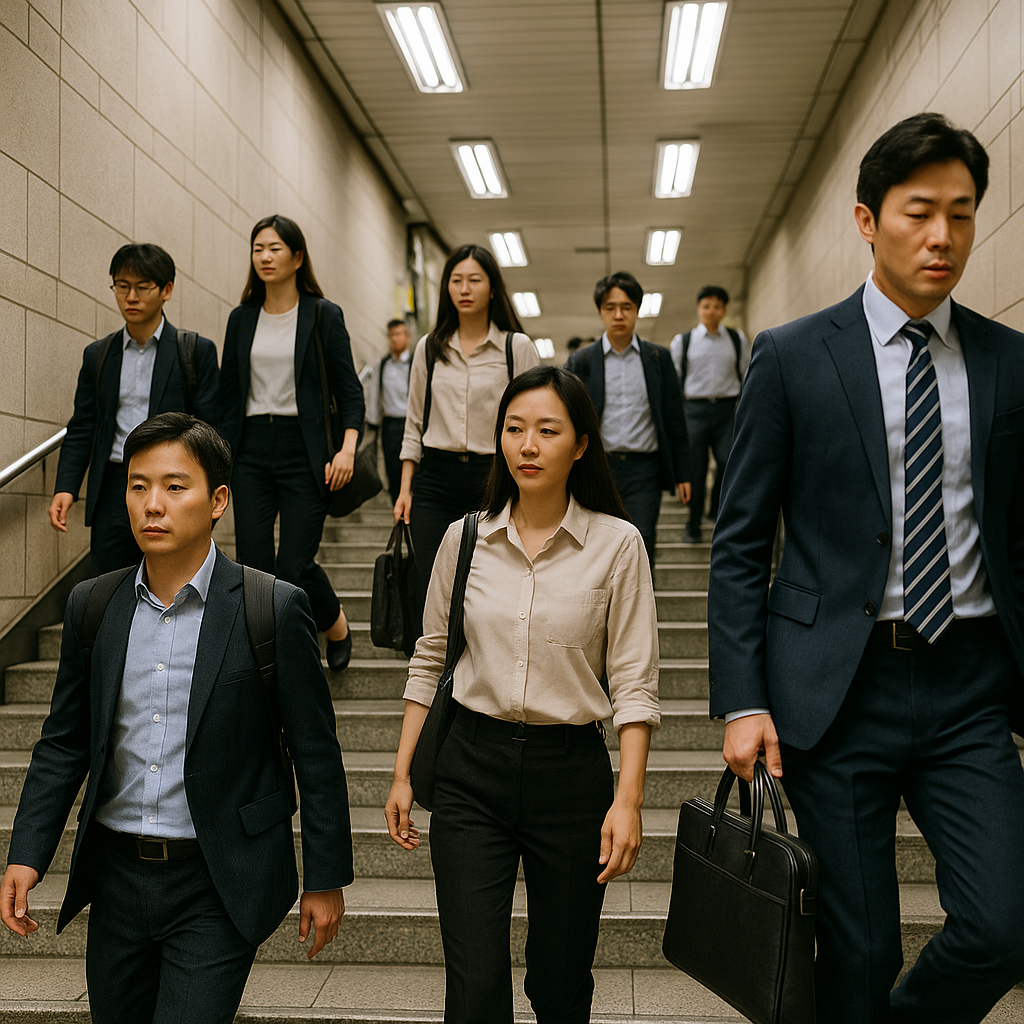
Spend five minutes in any Korean subway station and you’ll see it — people power-walking like they’re all late to the same emergency. Nobody strolls. Nobody meanders. Even old ladies with grocery carts move with intent. To outsiders, it looks like an entire nation running late. But that constant sense of urgency? It’s not stress — it’s structure.
The “빨리빨리” (Ppalli-Ppalli) Mindset
There’s no understanding modern Korea without knowing one phrase: “빨리빨리” (ppalli-ppalli) — it literally means hurry, hurry.
It’s not just a saying. It’s an operating system.
This “hurry culture” grew out of post-war necessity. After the Korean War, the country had to rebuild from almost nothing — fast. Everything became about speed, growth, and survival. Efficiency wasn’t a luxury; it was life itself.
Decades later, that instinct stuck. The same mindset that rebuilt a nation now drives how people walk, eat, text, and even breathe in cities like Seoul.
So when you see Koreans sprinting through subway tunnels or wolfing down kimbap in five bites, it’s not because they’re all late — it’s because “slow” feels unnatural.
Actually, even when there’s no rush, the idea of slowing down can trigger discomfort. A Korean friend once told me, “Walking slowly makes me anxious. It feels like wasting other people’s time.” That sums it up perfectly.
Urban Design That Encourages Motion
Korean cities are literally built for speed. Seoul, especially, functions like a high-efficiency circuit board: escalators everywhere, fast transfer tunnels, arrows guiding human traffic.
Public transport schedules are tight — trains every 2–3 minutes, buses synced by GPS. You move fast because the system moves fast.
Even the escalators reflect it: right side for standing, left side for walking (and yes, people actually respect it). If you pause mid-step on a busy day, you’ll feel that subtle collective pressure — not hostility, just momentum.
And it’s contagious. Foreigners who stay a few weeks start mirroring it. You begin walking faster without noticing. You get irritated when someone blocks the escalator. You start timing your transfers to the second.
There’s something hypnotic about it — a synchronized urban rhythm that pulls you in.
In Western cultures, time is personal — “my time, my schedule.” In Korea, time feels collective.
That’s why punctuality isn’t just appreciated — it’s moral. Being late isn’t a private inconvenience; it’s a social disruption. You’re slowing down the group.
It’s also why people move so fast in public spaces: they’re subconsciously maintaining social harmony. By moving efficiently, they’re respecting everyone else’s time.
I couldn’t find official studies on this, but it aligns with Korea’s group-oriented values — where the comfort of the collective outweighs individual convenience. So the rush isn’t selfish; it’s cooperative.
The Influence of Work Culture
Let’s be honest — the Korean work ethic is legendary. Long hours, constant competition, and high performance standards bleed into daily behavior.
Even off the clock, that mindset lingers. People walk like they’re between meetings, even if they’re just heading to a café. Students dash through subway gates like they’re late for exams.
And while younger generations are pushing back against overwork, the behavioral residue remains. “Moving fast” equals “being responsible.” “Lingering” equals “being lazy.”
Thing is, it’s not always conscious. It’s muscle memory — generations of productivity training encoded into body language.
The Technology Feedback Loop
Korea’s tech ecosystem reinforces the same tempo. Delivery apps drop food in under 15 minutes. Subways have countdown timers accurate to the second. Wi-Fi connects before your thumb lifts off the screen.
You live surrounded by micro-efficiencies. So you adapt — mentally and physically — to instant results.
I once timed my own routine: order coffee, receive text confirmation in 3 seconds, pick it up in under 2 minutes. The city moves like a digital organism — fast, synchronized, relentless.
And if you pause too long? You feel out of sync. Like lag in a high-speed system.
The Psychology of Space Pressure
Seoul’s population density is around 16,000 people per square kilometer — that’s tighter than Tokyo or New York. With that many bodies moving through small spaces, motion becomes survival.
If everyone slowed down, everything would collapse. Crowds rely on rhythm.
So rushing isn’t aggression — it’s coordination. People weave through each other seamlessly, rarely bumping, never apologizing. There’s an unspoken choreography to it.
Interestingly, once you match the pace, the chaos feels strangely peaceful — like surfing in a sea of momentum.
When “Hurry” Becomes a Habit
There’s a quiet downside to all this, too. Koreans often joke about being unable to relax, even on vacation. “Ppalli-ppalli” leaks into leisure time — fast travel itineraries, quick meals, rushed sightseeing.
Cafes sell “take-out culture” not because people can’t sit, but because sitting feels unproductive.
It’s not burnout exactly — more like the national nervous system never idles.
You’ll see people checking their phones while crossing the street, eating while walking, even half-jogging to catch elevators. The irony is, no one’s angry about it. It’s just normal.
The Generational Shift
That said, change is happening. Younger Koreans are increasingly rejecting the constant rush. “Slowness” is becoming trendy — slow living, slow cafés, even slow fashion.
There’s a growing “느림의 미학” (the beauty of slowness) movement, especially among creatives and expats who settled long-term. These pockets of calm — hanok cafés, nature getaways, minimalist retreats — are rebellion against the urban tempo.
Still, old habits die hard. Even in “slow” cafés, you’ll see customers typing furiously on laptops, earbuds in, shoulders tense. Old culture running inside new aesthetics.
What Foreigners Should Know
If you’re visiting or moving to Korea, the best way to handle this isn’t to fight it — it’s to synchronize with it temporarily.
Walk faster. Speak succinctly. Don’t block escalators. Respect the flow.
But also, learn to carve out micro-moments of calm for yourself — a park bench in Yeouido, a quiet teahouse in Insadong, a late-night stroll after 11 PM when the city finally exhales.
That balance is how Koreans survive the tempo without collapsing under it. And once you find it, Korea stops feeling rushed — it starts feeling alive.
FAQ
Why do Koreans walk so fast?
It’s habit and culture — efficiency is valued, and moving quickly is seen as respectful of others’ time.
Are Koreans stressed all the time?
Not necessarily. They’ve adapted to a fast rhythm; it feels normal, not frantic.
Do people ever slow down?
Yes, especially in cafés or countryside areas. But in cities, pace rules.
Is it rude to walk slowly in public?
Not rude, but you’ll probably get subtle side glances if you block the flow.
Where can I experience the slower side of Korea?
Try Jeonju, Gyeongju, or smaller coastal towns. Even Seoul has slow districts like Buam-dong or Seochon.
Does the “hurry” culture affect mental health?
Sometimes — burnout and anxiety are common issues, especially among office workers.
Unrelated — why are Koreans always on their phones?
It’s part of the same efficiency loop: mobile tools streamline life, so they’re used constantly.
Are younger Koreans rejecting the “ppalli-ppalli” mindset?
Increasingly yes, though the overall pace of life is still fast.
How should foreigners adapt?
Move with the flow. Avoid standing still in crowded paths. Be time-conscious.
Is the rush part of Korea’s success?
Absolutely. The national tempo mirrors its rapid modernization — but now it’s learning to breathe again.