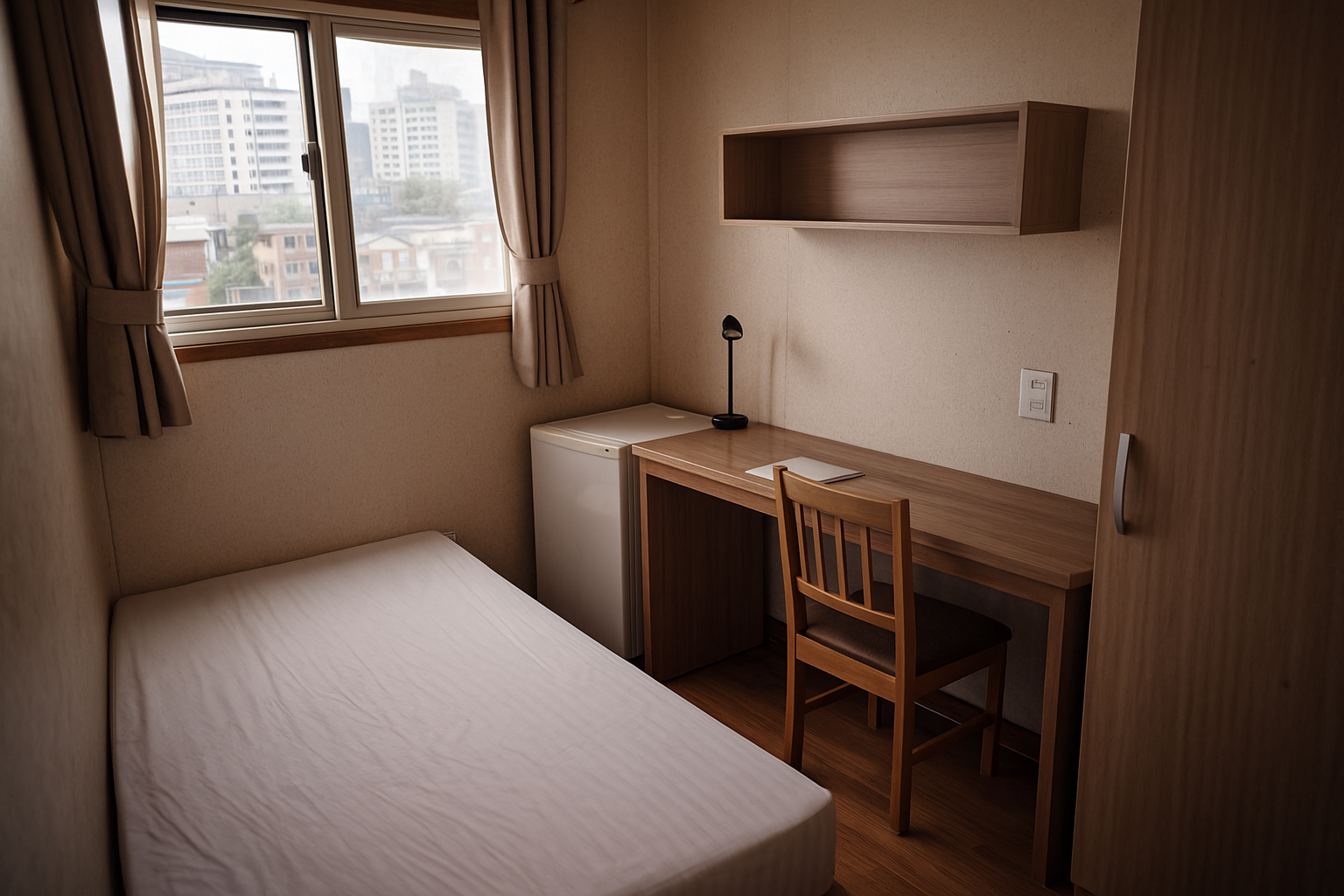
It’s one of those things you don’t quite notice until you’ve lived in Korea for a while — those narrow doors stacked along dim hallways with names like “Dream House” or “Study Stay.” They’re not hotels. Not apartments either. They’re goshiwon — the most compact form of housing you can find in South Korea, somewhere between survival and solitude.
The first time I stepped into one, it honestly felt like a large closet pretending to be a room. But then again, thousands of people live like that — students, freelancers, sometimes even middle-aged office workers who can’t afford a bigger place.
Let’s try to unpack what goshiwon really is, beyond the stereotypes.
The Origins of Goshiwon: From Study Cells to Survival Housing
Originally, goshiwon (고시원) were meant for goshi students — those studying for Korea’s notoriously brutal civil service exams (gosisaeng). The name literally means “exam house.” The idea was simple: a small, cheap room to study 24/7 without distractions.
But over time, the goshiwon drifted from its academic roots. Somewhere around the 2000s, as Seoul’s housing prices exploded, the people renting these rooms shifted too. Not just students anymore — but delivery riders, part-time workers, immigrants, and people in transition.
Thing is, some of these places barely meet housing standards. I remember reading a Reddit thread where one guy described his room as “hotter than a toaster in summer and colder than a fridge in winter.” And yet, for ₩300,000 a month (roughly $230), it’s a roof.
I couldn’t confirm the exact number of goshiwon in Seoul — estimates vary between 10,000 and 15,000 — but their presence is unmistakable. Especially around universities like Yonsei or Konkuk, or dense areas like Sinchon or Jongno, you’ll see signboards advertising “one-person rooms, meals included.”
What It’s Actually Like to Live in a Goshiwon
Room Size and Comfort
The average room size is around 3–6 square meters. You get a desk, bed, maybe a mini fridge, sometimes a tiny window. Bathrooms are often shared, unless you pay more for a “mini suite” with a private toilet squeezed in.
Some goshiwon even offer free rice, kimchi, and instant ramen in the communal kitchen — which sounds nice until you realize everyone uses the same pot.
But it’s not all bleak. There’s something weirdly efficient about it. You can clean your entire “apartment” in five minutes. Rent is month-to-month, no deposit required. You don’t even need an ID in some places — though that’s changing after safety incidents.
One girl I met in Mapo said she actually liked it. “I didn’t feel lonely because you can always hear someone coughing next door,” she laughed. Dark humor, but kinda true.
There’s a subtle etiquette among goshiwon residents. You don’t talk in the hallways. You don’t cook strong-smelling food. You never, ever leave your laundry longer than necessary.
And there’s this invisible social line — people who live in goshiwon temporarily vs. those who have nowhere else to go. You can sense it. One stays up late studying, the other stares at their phone for hours.
Actually, one of the saddest things I found was how goshiwon are linked to jjokbangchon (tiny room villages), which are even smaller and poorer. There’s overlap — older people who can’t afford rent anymore often end up moving from goshiwon to jjokbang. The government has been trying to regulate them better, but honestly, I’m not sure it’s working.
Still, not all goshiwon are depressing. Some new ones are branded as “micro studios” or “co-living spaces,” with trendy names and pastel walls. They’re basically the gentrified version of the same idea — tiny, private, minimalist.
So, maybe goshiwon aren’t just about poverty anymore. They’ve become part of a larger conversation about how Koreans — especially young ones — are redefining independence in small spaces.
Safety, Fire Risks, and Recent Changes
If you Google “goshiwon fire,” you’ll see why people worry. The 2018 Jongno fire killed seven residents, many of whom were elderly or job seekers. It sparked national outrage and new safety regulations — mandatory sprinklers, emergency exits, that sort of thing.
But not every building follows those rules yet. Especially the older ones built before 2000. I saw a YouTube video by a Korean journalist who checked random goshiwon around Seoul — some didn’t even have a second exit. That’s terrifying when you realize how narrow the corridors are.
Thing is, they’re still legal because they fill a housing need. For a lot of people, it’s either that or sleeping in a PC bang.
Recently, there’s been a push to rebrand goshiwon as “one-roomtel” or “sharehouse”, giving them a cleaner image. You’ll see fancy ones with digital locks, air purifiers, even soundproofing. Costs about ₩600,000 or ₩700,000 a month — still cheaper than a studio, but not by much.
Why Goshiwon Still Matter (Even When They Shouldn’t Have To)
In a way, goshiwon represent Korea’s contradiction: an ultra-modern society where people still live in closet-sized rooms. They show how urban life compresses ambition into small boxes — literally.
And yet, for some, it’s freedom. No long leases, no pressure. Just a bed, Wi-Fi, and a door that locks.
One former resident wrote online, “I moved out of my goshiwon, but sometimes I miss it. It felt like a reset button.”
Maybe that’s the essence of it — goshiwon as both escape and confinement. A space where you can start again, or get lost completely.
FAQ
How much does a goshiwon cost in Seoul?
Usually between ₩250,000 to ₩600,000 per month, (190USD to 460USD) depending on location and size.
Do foreigners live in goshiwon?
Yeah, plenty. Especially exchange students and language learners — it’s an easy way to live short-term without a deposit.
Is it safe to live in one?
Mostly, yes. But check for sprinklers, emergency exits, and CCTV before moving in.
Can couples live together in a goshiwon?
Nope. Rooms are strictly single-occupancy.
Why are goshiwon so small?
Because they were never meant for comfort — just for studying or temporary stays.
What’s the difference between goshiwon and goshi-tel?
Practically the same, though “goshi-tel” sounds fancier and may include better facilities.
How do you find one?
There are sites like Gosiwon.kr or Craigslist, but honestly, many people just walk around the neighborhood and check signboards.
Is there Wi-Fi?
Yes, always. It’s one of the few perks.
Why do Koreans still use them?
Because Seoul rent is insane. Simple as that.
Does it smell weird?
Sometimes. Depends on your neighbors.
I don’t know — is goshiwon life depressing?
For some, yeah. For others, it’s just practical. Like living in a capsule hotel indefinitely.
“What Is Goshiwon in South Korea? A Tiny Room With a Big Story”에 대한 2개의 생각