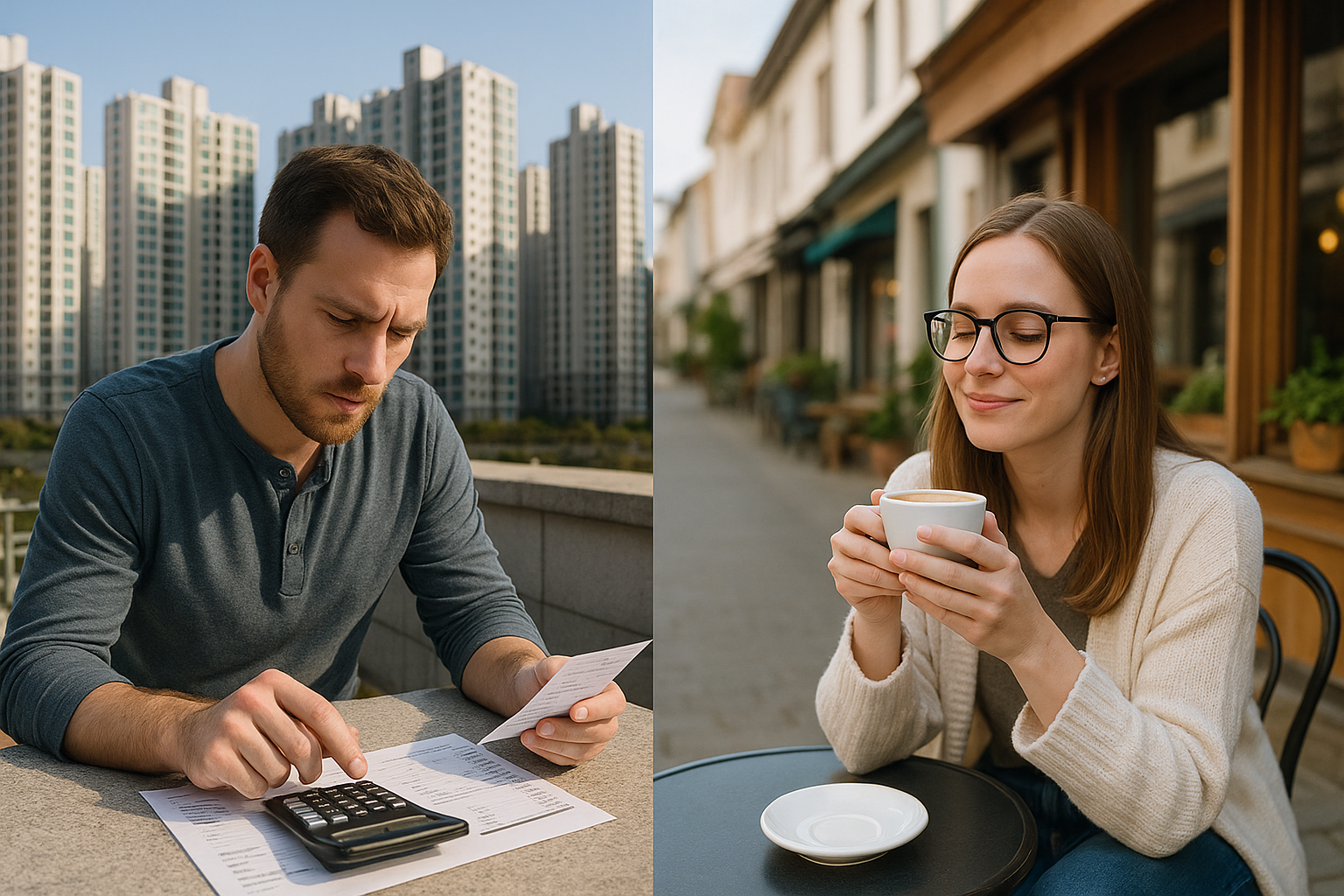
Seoul’s amazing. Until rent day hits, anyway.
Everyone says it’s expensive. But how expensive? Well, that’s complicated. I met this guy from Busan once who told me his entire apartment costs less than those tiny officetels in Gangnam. Thought he was messing with me. Turns out he wasn’t even exaggerating.
Here’s the thing about Seoul — it’s basically running its own separate economy. The prices feel disconnected from everywhere else in Korea. Like Seoul decided to use different currency or something. What gets me is you don’t always see where the extra money goes. Food costs more. Transport adds up. Housing obviously. Even getting your hair cut somehow costs more here.
And yet people keep coming. Jobs are here. Everything’s convenient. There’s this energy you just can’t find anywhere else. Makes it worth it, I guess? Or maybe we just enjoy having something to complain about.
Housing: The Part That Really Hurts
Okay so housing in Seoul. No sugar-coating this one — it absolutely destroys your budget.
A one-room officetel near Hongdae or Gangnam? Nine hundred thousand won monthly. Sometimes more if you actually want sunlight. Or a bathroom door that closes all the way. Meanwhile my friend in Daegu pays literally half that. For MORE space. With an actual kitchen that fits more than a kettle.
Jeonse used to save you, right? That lump-sum deposit system everyone talked about. Now though? Feels like a trap honestly. Deposits hit three hundred million won in central Seoul. For what exactly? Some 30-year-old apartment with wallpaper that looks… suspicious.
In smaller cities that same money could buy you a small house. Not rent. Buy.
What’s wild is it’s not just the fancy neighborhoods anymore. Mapo used to be affordable for students. Gwanak too. Both got swept up in this rent wave. Saw someone post on Naver Café about moving to Incheon just for cheaper rent. Still works in Seoul though. Commutes two hours. Every. Single. Day.
That tells you everything you need to know.
Quick reality check on smaller cities
Busan has expensive coastal spots, sure. Haeundae, Gwangan area. But you can still find sea-view studios under six hundred thousand won. Daejeon? Some landlords there still take monthly rent in cash, old-school style. And Gwangju — honestly feels like 2010 prices. Almost nostalgic.
Daily Expenses: Death by a Thousand Small Purchases
Big bills aren’t what kills you. It’s the six-thousand-won coffee. The eighteen-thousand-won lunch. “Just one drink” that becomes a sixty-thousand-won night you barely remember.
Seoul normalizes spending. That’s its superpower. Everything’s close, everything’s open late, and your wallet doesn’t stand a chance. You grab taxis when it rains instead of walking. Order dinner because the supermarket already closed. Next thing you know it’s the end of the month and you’re wondering where everything went.
Did this comparison once — bought the exact same groceries at Homeplus in Seoul and Daegu. Same brands, same items. Twenty percent cheaper in Daegu. Convenience stores too. Even those GS25 triangle kimbap things somehow cost more in Seoul. Probably the rent thing? Couldn’t confirm it but it FEELS true.
Public transport’s still cheap compared to other countries. Fourteen hundred won for subway rides. That’s assuming you stay in Seoul though. Go beyond the city limits — Suwon, Ilsan, anywhere — and transfer fares quietly climb higher. Daegu’s subway costs about the same, but distances are shorter. You end up spending less overall.
Busan taxis are cheaper too, which shocked me. Paid five thousand won for a ten-minute ride there once. Same distance in Seoul was nine thousand. Do the math on a month’s worth of nights out. That’s basically a week of groceries gone.
Eating Out and Groceries: Where Seoul Really Gets You
This part genuinely hurts.
Eating out used to be fun. A nice treat. Now it’s practically a luxury event you need to budget for.
Simple kimchi jjigae lunch used to be six thousand won. Now it’s pushing ten thousand or more in central areas. In smaller cities like Jeonju you can still get it under seven thousand. And honestly? Usually tastes better. Seoul’s got style, yeah. But you’re definitely paying “Seoul tax.”
Groceries are painful. Fruit especially. Single apple at a Seoul convenience store can be two thousand won. In Gwangju I bought FIVE apples for that price. Not joking. People in smaller cities still go to local markets where you can haggle. Seoul markets like Gyeongdong or Namdaemun are becoming tourist zones now. Not actual affordable shopping spots anymore.
Coffee culture though. Don’t even get me started. A café latte costs roughly the same everywhere in Korea. Seoul’s problem is density. You walk fifty meters and there’s another café. So coffee isn’t technically more expensive. You just end up buying way more of it. See the trap?
Work and Lifestyle: The Tradeoff Nobody Wants to Admit
So why do people keep moving here?
Jobs. Opportunities. Networking. Everything important orbits around the capital. That’s what traps you.
You could live comfortably in Gwangju on 1.5 million won monthly. In Seoul that’s borderline survival mode. But here’s the catch — the same job in Gwangju might pay twenty to thirty percent less. It’s this twisted equation. Lower costs but lower pay.
Met this designer once who left Seoul for Daegu. Salary dropped, yeah. But she said she finally had “mental space.” Rent got cut in half. Commute dropped to ten minutes. “I’m not rich,” she told me. “But I stopped feeling poor.”
That stuck with me.
Seoul gives you access. Best restaurants, culture, gigs, everything. But also constant pressure. The pace is honestly intoxicating. Also exhausting. Other cities move slower. You can breathe easier. Feel that difference in your wallet and your mood.
What people forget to count? The invisible stuff. Mental health. Time. Opportunity costs.
Seoul charges you indirectly for everything. Long commutes, burnout, noise. That feeling you’re always slightly behind everyone else.
In places like Daejeon or Ulsan people finish work and go home. Cook dinner. Normal stuff. In Seoul you finish work and somehow it’s already ten p.m. Order delivery again. Another twenty-five thousand won vanished.
Social pressure’s different too. Seoul has this unspoken “presentation cost.” You dress better. Eat at trendier places. Even haircuts cost thirty percent more. Nobody requires it. But it’s there. This quiet competition happening.
Read somewhere — think it was Reddit — that living in Seoul feels like living in HD. Everything sharper, faster, more intense. True. But like HD streaming, it eats your bandwidth.
So… Is It Actually Worth It?
Maybe? Depends on your chaos tolerance honestly.
If your job demands Seoul, you accept higher costs as the tradeoff. Makes sense. But if you’re working remotely? Hard to justify really. Other cities give you eighty percent of Seoul’s convenience for half the price.
Leaving Seoul feels like giving up something intangible though. The pulse. The energy. That buzz. But once you adjust to a smaller city you realize how much of your budget was tied up in just surviving. Not actually living.
Weird realization.
FAQ
How much does it cost to live in Seoul per month? For a single person maybe around two to 2.5 million won if you’re not going crazy. More if you’re in central areas obviously.
Which Korean city is the cheapest to live in? Probably Gwangju or Ulsan. Depends on your lifestyle though.
Is Seoul more expensive than Tokyo? Kinda yeah. Housing-wise definitely. Food and transport not really.
Why is Busan cheaper but still feels “big city”? Because it’s legitimately big without Seoul’s national-centralization problem. Seoul absorbs too much of everything — talent, government money, rent inflation, all of it.
Do locals ever actually move out of Seoul? Yeah definitely. Especially after getting married or burning out. Lots move to satellite cities like Suwon or Paju.
Weird question but are haircuts cheaper outside Seoul? Yep. Daegu maybe fifteen thousand won. Gangnam thirty to forty thousand easy. Sometimes more.
Would I regret not living in Seoul? Maybe. Maybe not honestly. Depends if you value peace or stimulation more. Can’t answer that for you.