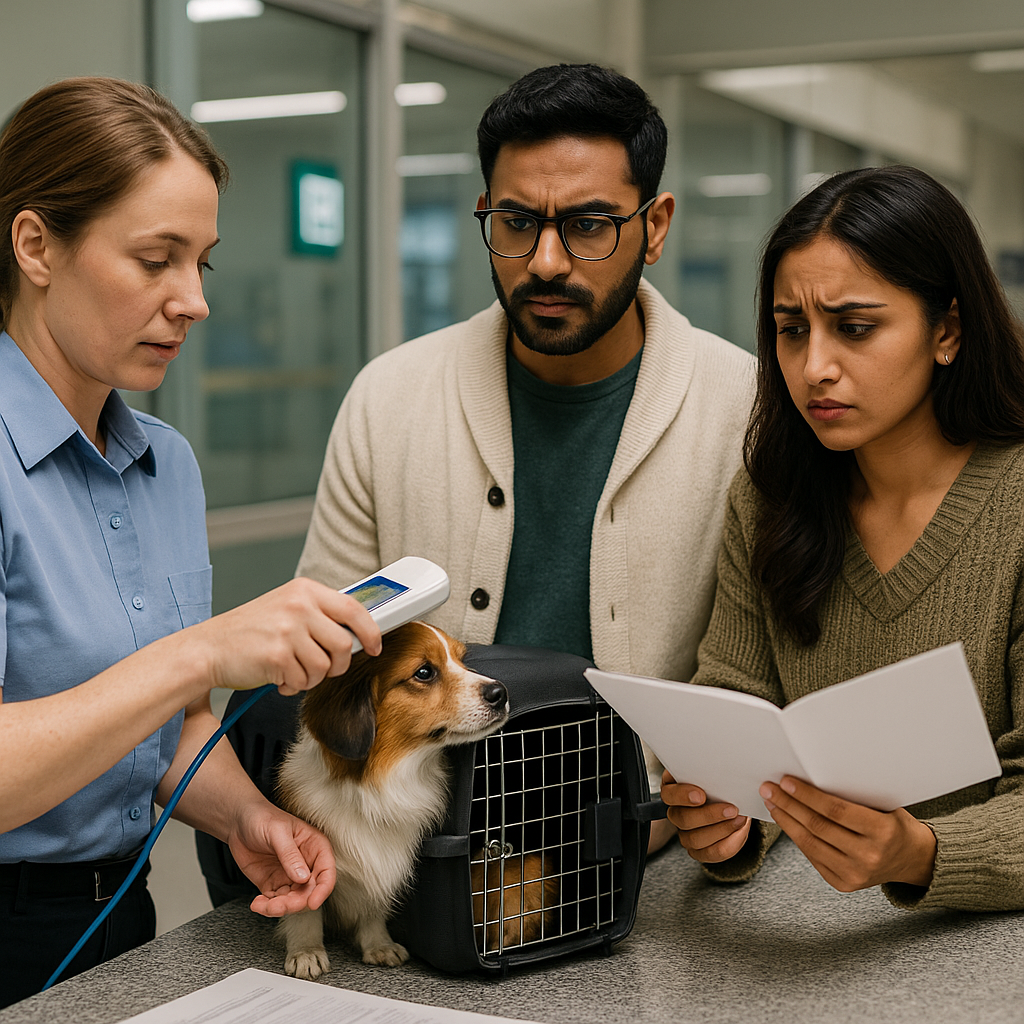
Few things spike your heart rate faster than watching an airport quarantine officer scan your pet, frown, and say, “The number doesn’t match.” It happened to me at Incheon Airport once — my cat’s microchip scanned as one digit off from the number printed on her vaccine certificate. Just one. I thought I was doomed.
Turns out, this kind of problem happens more often than you’d think. Between vet typos, outdated chips, and mix-ups at the clinic, mismatched microchip numbers are one of the most common reasons pets get delayed at Korean customs. Luckily, most of these issues can be fixed — either before you fly or, in some cases, at the airport with a bit of patience and proof.
Here’s what’s really going on when your pet’s chip number doesn’t match, and what you can do about it.
Why Microchip Numbers Matter So Much
For South Korea’s Animal and Plant Quarantine Agency (APQA), the microchip is everything. It’s your pet’s “passport number,” linking them to their vaccination record, health certificate, and every other piece of documentation. If the number scanned at the airport doesn’t match the one printed on your paperwork, customs can’t verify that your dog or cat is the same animal described in those forms.
That’s why the rule is strict:
- Every microchip must be ISO 11784/11785 compliant (15-digit format).
- It must be implanted before the rabies vaccination.
- The exact number must appear on every single document — the vaccine certificate, the health certificate, and any antibody test results.
If even one digit is wrong or missing, it can trigger a hold, inspection delay, or full quarantine.
The Usual Culprits Behind a Mismatch
When customs says “the number doesn’t match,” it doesn’t always mean your pet’s chip is fake or broken. Most of the time, it’s human error somewhere in the paper trail.
Here are the common scenarios:
- Vet Typo or Formatting Error
- Example: The actual chip number is
985121045678912, but your certificate says985 121045678912or98512104567891. One space or missing digit can cause confusion. - Fix: Ask your vet to reissue the certificate with the exact 15-digit format, no spaces, no punctuation.
- Example: The actual chip number is
- Different Microchip System
- Older chips or non-ISO types (like 10-digit or alphanumeric ones) sometimes can’t be read by Korean scanners.
- Fix: If your chip isn’t ISO-compliant, either bring your own reader or have your vet implant a second ISO-compliant chip before travel. Just make sure both numbers appear on the health certificate.
- Reused or Outdated Records
- Sometimes owners reuse old vaccine certificates that were issued before a chip was implanted. Customs sees this and flags it.
- Fix: Always use documentation linked to the most recent vaccination done after microchipping.
- Multiple Pets, Swapped Numbers
- It sounds dumb, but vets sometimes accidentally switch pet details — especially if you’re exporting more than one animal.
- Fix: Double-check every line on your forms before you leave the clinic. Compare each pet’s scanned number to the paperwork immediately.
- Unreadable or Faulty Microchip
- Rare, but it happens. Chips can migrate under the skin or malfunction after years.
- Fix: Have your vet rescan your pet before travel and confirm readability. If it’s faulty, implant a new chip and update all records accordingly.
What To Do Before You Travel
Catching the problem before you board is infinitely easier than fixing it in another country. Here’s your pre-flight checklist:
- Scan your pet at the vet clinic and confirm the number matches what’s written on all certificates.
- Check the format — it should be exactly 15 digits, no letters or spaces.
- Reprint corrected documents if needed. Most vets can update the paperwork in minutes.
- Contact your country’s animal health authority (USDA, DEFRA, CFIA, etc.) if the corrected document needs to be re-endorsed.
- Bring old certificates showing vaccination history just in case you need to prove continuity.
Think of it like matching your passport number to your boarding pass — one wrong digit and you’re stuck at the counter.
What Happens If You Arrive in Korea and the Numbers Don’t Match
Let’s say you did everything right but somehow there’s still a mismatch at Incheon. Don’t panic — you’re not automatically in trouble.
Here’s how it usually goes:
- The APQA officer will rescan your pet a few times to confirm.
- If the chip is readable but doesn’t match the certificate, they’ll ask for proof (old records, vet confirmation, photos of the chip label, etc.).
- If they can verify it’s a documentation error — not a missing or fake chip — they’ll note it in your entry file and may let you through.
However, if they can’t confirm the number at all (like a faulty or unregistered chip), your pet might need temporary quarantine for further checks.
During quarantine, APQA vets may:
- Rescan the chip with different equipment
- Verify identity through vet statements or medical records
- Possibly test for rabies antibodies to confirm vaccine linkage
This can take a few days. You’ll be responsible for boarding and care fees during that period.
How to Prove It’s the Same Animal
If your pet’s paperwork doesn’t line up perfectly, you’ll want evidence that ties everything together. Here’s what helps:
- Microchip implantation record from your vet
- Photos of the microchip sticker label (often on the original certificate or vaccine book)
- Vet letter of confirmation, signed and dated, explaining any clerical errors
- Copies of previous vaccination records showing the same pet’s name, age, and breed
- Your own ID (to match ownership details on the health certificate)
The more supporting material you show, the more likely APQA will accept it as a documentation inconsistency rather than a compliance failure.
When You Should Get a Second Microchip
Sometimes the simplest fix is a new, ISO-compliant microchip — before you travel. This is common for:
- Pets with old 9- or 10-digit chips
- Animals whose chips can’t be read reliably
- Owners from countries that use different frequency standards
If you get a new chip, update all records immediately. The new microchip number must appear on:
- Rabies vaccination certificate
- Health certificate
- Antibody test results (if applicable)
- Export permit from your home country
You can list both numbers if your pet still has the old chip in place — just make sure the new one is clearly marked as “primary.”
Lessons Learned (from My Cat’s Airport Incident)
In my case, the chip mismatch was just a single digit typo. Luckily, I had my vet’s signed letter and a clear photo of the chip sticker. The APQA officer reviewed it, nodded, and stamped my clearance. I’ve never guarded a piece of paper so carefully in my life.
It taught me something simple but crucial: check the microchip number on every single document before printing. Even the tiniest mismatch can cause unnecessary stress at the end of a long flight.
Key Takeaways
- Always use ISO-standard 15-digit chips.
- Ensure the microchip number appears exactly the same on every form.
- Fix typos or mismatches before leaving your home country.
- Carry backup proof like vet letters and chip sticker photos.
- If in doubt, re-chip and reissue the documents — it’s cheaper than quarantine.
A perfect paper trail equals a smooth airport experience. And your pet? They’ll thank you for not spending their first night in Korea behind a quarantine gate.
FAQ
Can I travel if my pet’s chip number is one digit off?
Technically, no — it must match exactly. But if you have official proof it’s a typo, APQA might accept it.
What if the microchip doesn’t scan at all?
You’ll need to provide alternate proof of identity. In worst cases, APQA may require temporary quarantine.
Can I implant a new chip right before travel?
Yes, as long as you update all vaccine and health records with the new number.
Will APQA reject pets with two microchips?
No, but you must list both numbers on your documents, with the newer one as primary.
Can my vet just write the number manually on a new certificate?
Yes, but it still needs official endorsement by your government’s animal health authority before travel.
What if the old records show a different chip number?
Bring all historical paperwork — it helps prove ownership and continuity.
Unrelated, but does Korea require chip registration after arrival?
Yes. You’ll need to register the microchip with your local city office within 30 days.
Korean Pet Quarantine Rules Explained: What APQA Actually Wants From You
Complete South Korea Pet Entry Checklist: Microchip, Rabies Certificate, and Quarantine Forms
“What If Your Pet’s Microchip Number Doesn’t Match the Records in Korea?”에 대한 1개의 생각