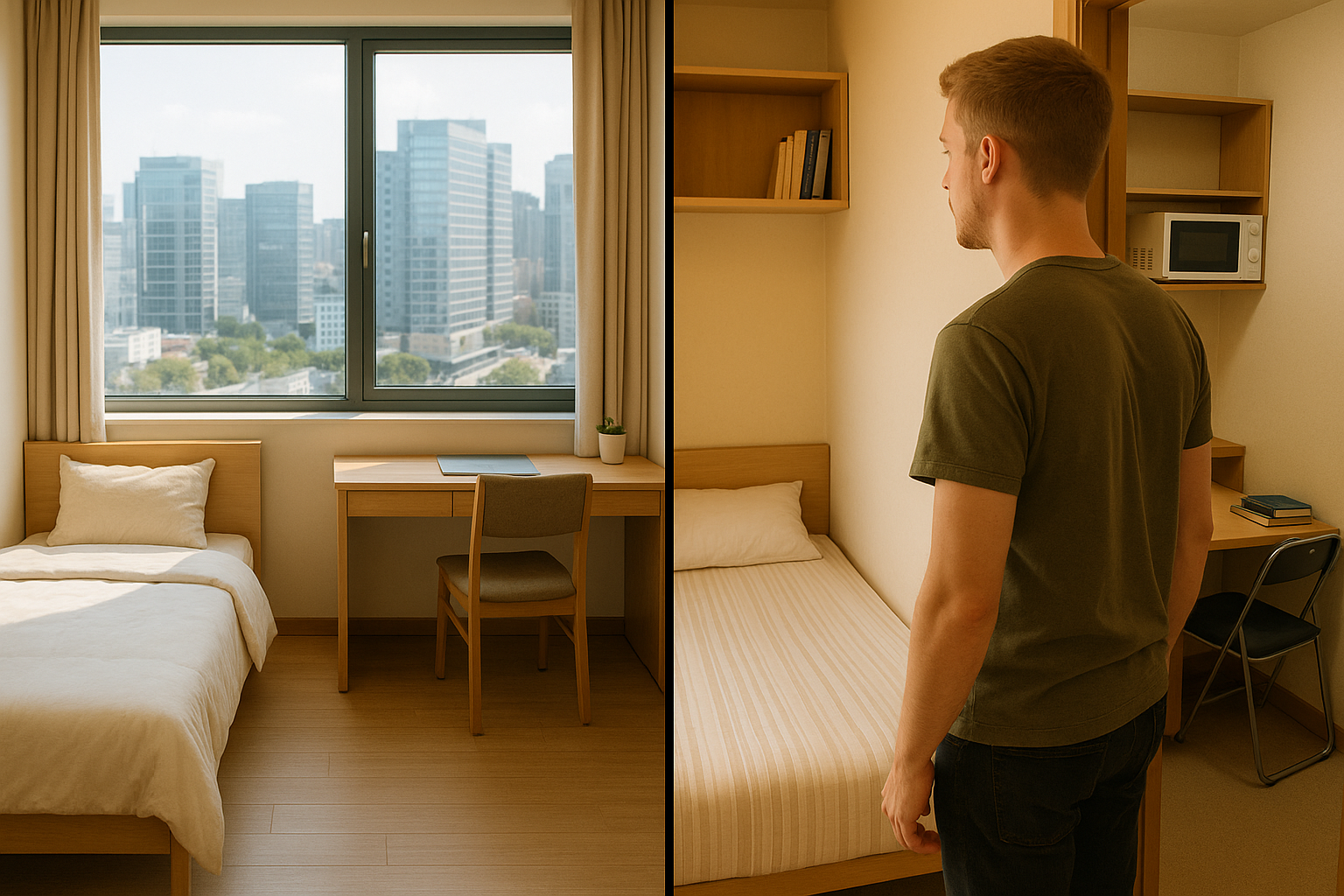
When I first moved to Seoul, I didn’t really get the housing system. I thought “one-room” just meant a studio apartment, and “goshiwon” was some kind of dorm. Technically true — but in Korea, those two words carry a lot of unspoken meaning.
The choice between them is almost a rite of passage for foreigners living here: comfort vs cost, privacy vs practicality. It’s weirdly emotional too. Because your room in Korea ends up shaping your whole experience — how you eat, who you meet, how much you sleep.
So, let’s talk about what really separates a one-room from a goshiwon, not just in size or rent, but in how it feels to live there.
What Exactly Is a One-Room in Korea?
A “one-room” (원룸) is basically the Korean version of a studio apartment. One space that fits your bed, kitchen, and maybe a washing machine. Usually it’s around 20–30 square meters, though I’ve seen ones closer to 15 that felt like a shoebox pretending to be a home.
You’ll find one-rooms everywhere — near universities, subway stations, or tucked into those odd half-basement buildings (banjiha).
Thing is, moving into a one-room means dealing with Korea’s rental system, which is… confusing. You’ll hear words like jeonse (big deposit, no monthly rent) and wolse (small deposit + monthly rent). For foreigners, wolse is the realistic option.
Typical setup? Around ₩5 million deposit and ₩600,000–₩900,000 monthly rent in Seoul, depending on area. Some landlords might ask for a Korean guarantor, which can be a headache if you’re new.
But you get your own space — bathroom, kitchen, even your own smell (which you’ll both love and hate).
So Then, What Is a Goshiwon?
Goshiwon has tiny single rooms, originally made for students studying for exams. Over time, they turned into the cheapest private housing available. Some call them “micro dorms,” others just say “legal closets.” Both are fair descriptions.
Average size? Around 3–6 square meters. That’s roughly the size of a walk-in closet. You get a small bed, desk, Wi-Fi, and shared kitchen. Some have private bathrooms, some don’t. Rent ranges from ₩250,000 to ₩600,000 per month — and that’s it. No deposit.
I once stayed in one for three months near Sinchon. It was… quiet. Too quiet. You could hear someone typing two doors away. But for a broke language student, it made sense.
Goshiwon are great for short stays or people who hate bureaucracy. You can move in the same day you visit. Cash, key, done. No contracts, no long-term pressure.
But yeah, it’s not for everyone. Claustrophobia is real.
The Real Differences You’ll Notice
1. Privacy
One-room wins easily. You can cook kimchi fried rice at midnight or play music without someone knocking. In a goshiwon, even zipping your jacket feels loud.
2. Cost and Commitment
Goshiwon is for survival mode. One-room is for settling down.
A goshiwon might cost half as much per month, but you’re paying for flexibility, not comfort. One-room requires more upfront cash but feels like your space.
3. Facilities
One-room: washing machine, stove, private bathroom.
Goshiwon: microwave in the hall, shared toilet, free rice.
It sounds harsh, but it’s accurate. Though new “premium goshiwon” blur the line, offering en-suite rooms and decent kitchens. Still, even the fancy ones can’t shake the “temporary” vibe.
4. Neighbors
In goshiwon, you rarely talk to anyone. Everyone is in survival or study mode.
In one-rooms, you won’t talk to anyone either — but for different reasons. It’s isolation with better walls.
Why Many Foreigners Start With a Goshiwon
It’s easy. That’s the main reason.
No deposit, no paperwork, no stress. When you’re new to Korea, maybe still figuring out your ARC (Alien Registration Card), a goshiwon gives you time. You can land, stay a month or two, and search for a better place.
Some people actually prefer it. Especially minimalist types. Everything you need within arm’s reach, Wi-Fi that never disconnects, rice that never runs out.
But others burn out fast. The lack of space messes with your brain after a while — you start craving sunlight, or just the ability to stretch your arms without touching both walls.
One-Room Life: Independence With a Price Tag
Once you get your documents sorted, one-room living feels like freedom. You can decorate, cook, and finally invite people over without awkward hallway encounters.
But be ready for maintenance costs — heating, internet, sometimes management fees. I once got a ₩120,000 gas bill in winter for a room smaller than my college dorm. Turns out I didn’t know how to use the ondol (floor heating).
Thing is, one-room gives you mental space too. After a few months, you stop thinking about how small it is and start treating it like your own base.
A Weird Middle Ground: One-Roomtel and Officetel
Somewhere between goshiwon and one-room are hybrids — “one-roomtel” (고시텔) or “officetel” (오피스텔).
A one-roomtel is basically a goshiwon pretending to be a one-room. You still have small space, but private bathroom and nicer design. It’s kinda like upgrading from hostel to budget hotel.
Officetels, on the other hand, are real apartments that double as offices. They’re modern, have elevators, security, and full kitchens. Expensive though — more like ₩1 million a month in central Seoul.
If you’re staying long-term (a year or more), an officetel might make sense. But if you’re here on a working holiday or just testing life in Korea, a goshiwon is fine to start.
Final Thoughts: What Feels Like “Home” Is Different for Everyone
Some people can thrive in 4 square meters; others feel trapped after a week. A one-room might sound better on paper, but the paperwork alone can kill your excitement.
What I learned after years here is that housing in Korea isn’t just about rent — it’s about rhythm. How you live, how much noise you can handle, how often you move.
A goshiwon suits the drifter or student phase. A one-room suits the “I’m staying for real” chapter.
Both tell a story about where you are in your Korean journey.
FAQ
Can foreigners rent a one-room easily?
Yes, but some landlords prefer locals. Using a real estate agent who speaks English helps.
Do goshiwon require a visa?
Not always. Some owners rent to tourists or students without a visa, though technically that’s a grey area.
Which is cheaper in the long run?
Goshiwon monthly, but one-room if you stay over six months — deposits are refundable.
Can you cook in a goshiwon?
Sometimes. Usually there’s a shared kitchen with basic stuff.
Is a one-room safer than goshiwon?
Generally yes — newer buildings, better fire systems, personal locks.
Do all goshiwon include rice?
Weirdly, yes. Free rice and kimchi are kind of their signature perk.
Why do Koreans still live in goshiwon?
Because rent is brutal and convenience wins.
Can couples rent a one-room together?
Yes, many do. Just make sure your lease allows it.
What’s a one-roomtel again?
Think “goshiwon deluxe.” Small but self-contained.
I don’t know… is goshiwon life lonely?
It can be. But so can a one-room. Depends what you make of it.
“One-Room vs Goshiwon: What Foreigners Should Know”에 대한 2개의 생각