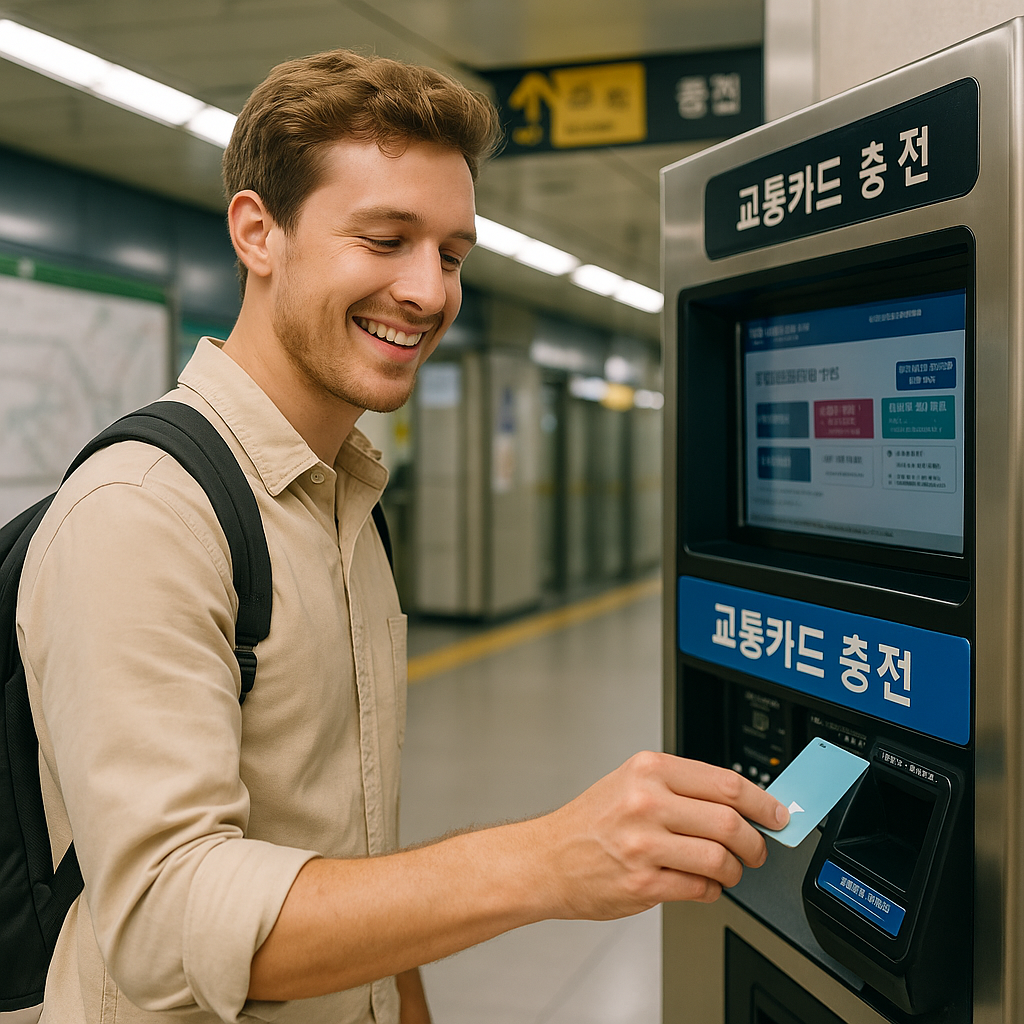
I remember my first week in Seoul — I stood in front of a reloading machine, tapping every button like an idiot. Everything was in Korean, I had 5 people waiting behind me, and somehow the machine started shouting in a robotic voice. Classic. But once you get the hang of it, topping up a T-Money card is ridiculously easy — even without speaking a word of Korean.
Understanding What “Top-Up” Really Means
First off, topping up means adding money — Korean won — to your T-Money card balance. It’s not linked to your bank account or credit card (unless you’ve set that up through a Korean app). Think of it like preloading your transit wallet.
Here’s the thing most travelers don’t realize: your T-Money card doesn’t automatically refill. Once it hits zero, it just won’t work — no warning, no mercy. The subway gate beeps red, people sigh behind you, and you’re suddenly “that person.”
And because the card’s balance is stored inside the chip (offline), it only updates when you physically add cash or use an official app. This makes it ultra-fast but also kind of old-school.
So yeah, you’ll need to top up regularly — maybe every few days, depending on how much you move around.
Option 1: Reload at a Convenience Store
This is the easiest way, hands down. Walk into a CU, GS25, 7-Eleven, or Emart24 — literally on every corner — hand your T-Money card to the cashier and say:
“T-Money chong-je haneunde yo” (I want to recharge my T-Money).
Then say how much: ₩5,000, ₩10,000, ₩20,000 — whatever works. They’ll take your cash (most don’t accept foreign credit cards for reloads) and tap the card on a small terminal. That’s it.
No forms, no ID, no fuss.
One slightly weird thing I noticed: some clerks don’t speak English, but they all recognize the word “T-Money.” Just hold up the card and say the amount you want — “ten thousand won” usually does the trick.
Option 2: Top-Up Machines in Subway Stations
The bright yellow reloading kiosks inside subway stations are another easy option — and maybe the most common. They’re usually near the ticket gates or by the walls near exits.
Most of these machines now have an “English” button in the top corner. Hit it first (seriously, don’t skip this — it saves you from menu confusion).
Then the flow goes something like this:
- Tap your card on the sensor area.
- Insert cash — bills only, no coins.
- Confirm the amount.
- Tap again when it says to finalize.
Done. Balance updated instantly.
You can usually load from ₩1,000 up to ₩90,000. And yes, you can check your balance there too.
But, small warning: not every station has functioning English menus. In older stations, the screens might lag or glitch. Once I ended up reloading twice because the screen froze. Didn’t lose money, but it took forever to refund.
Option 3: Mobile Apps (If You Have a Korean SIM)
This one’s tricky for foreigners. There’s a T-Money app that lets you recharge with a Korean credit or debit card, but it only works if your phone’s NFC chip is recognized by Korean networks.
So if you’re using a foreign SIM — even if it’s a roaming plan — chances are the app won’t verify you.
Some prepaid tourist SIMs (like KT or SK Telecom ones) now include T-Money integration, though. You might see a little “T” logo in your SIM kit — it means you can tap your phone instead of carrying a physical card. Pretty futuristic, but not always stable.
Personally, I wouldn’t rely on it. The app’s interface is… let’s say “dated.”
Option 4: Tourist Information Centers
This one’s underrated. Most tourist info centers in Seoul, Busan, or Incheon Airport will top up your T-Money if you ask nicely. Some even have English-speaking staff who’ll do it for you on the spot.
They usually accept both cash and Korean cards. International cards? Hit or miss.
It’s not the most efficient route, but if you’re already there asking about directions, you might as well get your card reloaded.
What Foreigners Often Get Wrong
Weirdly, a lot of tourists assume they can recharge T-Money with credit cards. Nope. Unless it’s a Korean card, it won’t work. You’ll need cash. Always.
Also, don’t confuse “checking the balance” with “recharging.” Many convenience stores can check your remaining balance, but they can’t always reload digital versions linked to phones. Physical cards are safer that way.
And no — Apple Pay and Google Pay can’t replace T-Money yet. Korean transit gates use their own local NFC network. You can’t just tap your iPhone wallet and expect it to work (I tried. It beeped angrily).
Another minor mistake: trying to reload with coins. Machines don’t accept them, ever.
How Much Should You Load?
Depends on your lifestyle. For example:
- Short-term tourist (4–5 days): ₩20,000–₩30,000 should last.
- Daily commuter: ₩50,000+ for peace of mind.
- If you take subways + buses often, maybe ₩10,000 every two days.
Thing is, you can always top up anytime — even at 3 AM. That’s the beauty of Korea’s 24-hour convenience store culture.
Actually, if you forget to reload before a late bus, some drivers now accept T-Money top-ups via their in-bus terminal. But I’ve only seen that once — might depend on the region.
A Little Cultural Side Note
There’s something symbolic about this whole process. Korea’s entire public transit system depends on small, trust-based automation. No ID checks, no bureaucracy — just small plastic cards and quiet efficiency.
Foreigners often notice how frictionless it is, yet few realize how much coordination goes into keeping it that smooth. Every tap sends microdata into Seoul’s transport system, feeding optimization algorithms.
I found an old city report suggesting that T-Money data influences bus route changes — like if a certain line gets fewer taps, they shorten its schedule. That’s kind of cool. Or creepy, depending on your mood.
FAQ
Can I top up with a foreign credit card?
No, only Korean-issued cards work for app reloads. Use cash instead.
What’s the minimum top-up amount?
Usually ₩1,000, though some machines round up to ₩5,000.
Where can I see my remaining balance?
Check it at reloading machines, subway gates, or convenience stores.
Can I use USD or foreign currency?
Nope, only Korean won.
Can I top up a friend’s T-Money card?
Sure, just hand it to the cashier or use a machine. Doesn’t matter whose name it’s in.
Is there a way to auto-recharge?
Not for foreigners unless you have a Korean bank account.
Do I need to carry cash all the time?
Yes, for reloading. Korea’s digital, but this system still loves physical bills.
Unrelated question — can T-Money work in Japan or China?
Nope. It’s strictly domestic.
What if the machine eats my cash?
Ask a nearby station worker. They can open the machine and refund it manually.
Is it safe to hand my card to a cashier?
Totally. They just tap it and hand it right back.