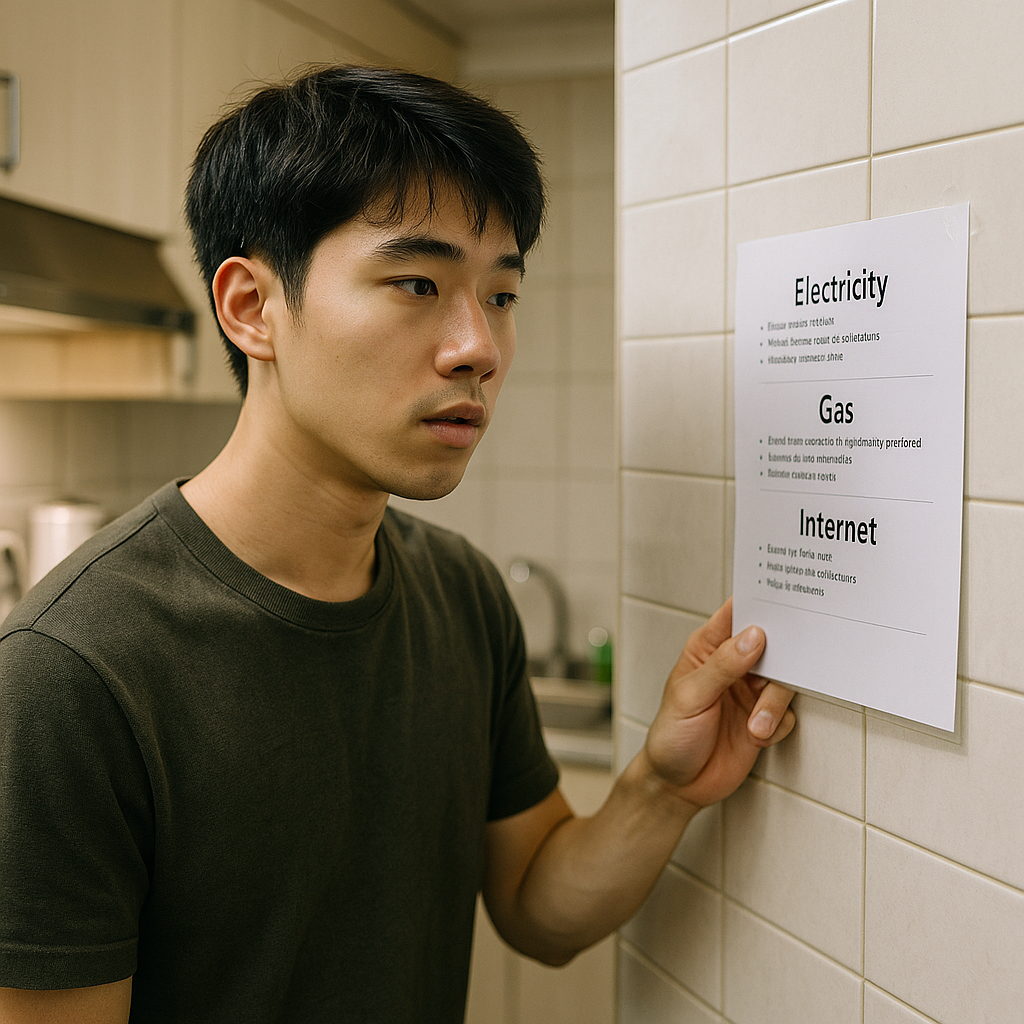
The first time I lived in a goshiwon, I thought I’d scored a great deal — ₩420,000 a month, no deposit, free rice. Then summer hit, and suddenly the air conditioner took coins. Every 10 minutes, ₩100 gone. That’s when I learned that “utilities included” in goshiwon ads doesn’t always mean what you think it does.
Korean goshiwons love to advertise “all-in-one” pricing, but behind that phrase hides a maze of small exceptions. Some are fair, some are borderline scams, and a few are just baffling (like charging for hot water at certain hours). Let’s unpack what’s actually included, what’s not, and what you should quietly check before signing or paying anything.
What “Utilities Included” Really Means in a Goshiwon
Most goshiwons include basic utilities — electricity, water, internet, and heating — in the rent. That’s the selling point. You pay one fixed monthly price and don’t have to deal with separate bills.
But here’s the messy truth:
- Air conditioning might have a coin system or time limit.
- Laundry might be coin-operated (₩1,000–₩2,000 per wash).
- You might get “free” rice and kimchi, but no cooking oil or seasoning.
- Wi-Fi? Yes, but the speed varies like the weather.
It’s an informal system built on convenience more than fairness. Owners assume tenants use utilities responsibly — which, in tiny buildings packed with 20+ residents, never happens. So, some try to offset those costs quietly through sneaky add-ons.
I remember a goshiwon in Hongdae that had a note in the hallway: “Please use air conditioning only between 8 PM–11 PM.” No joke. When I asked why, the ajumma said, “Electric bill too high.”
Common Things That Are Included (and Usually Reliable)
Let’s start with the stuff you can actually count on.
Electricity – Always covered, though sometimes limited during summer. The wiring in older buildings can be sketchy, so if you hear buzzing near outlets, maybe unplug your laptop at night.
Water – Unlimited, usually fine. No extra charge unless you flood the bathroom (don’t laugh, it happens).
Heating – Korean goshiwons use central or floor heating. It’s included, but the temperature might not be under your control. You’ll see signs like “Do not change the setting” taped over thermostats.
Internet/Wi-Fi – Definitely included, but if you’re gaming or working remotely, prepare for lag. It’s often shared bandwidth for the entire floor.
Rice and Kimchi – The legendary combo. Always available, though quality varies wildly. In fancier goshiwons, you might also get eggs or ramen. In cheaper ones, it’s just endless cabbage.
The Sneaky Extra Costs Nobody Mentions
Here’s where things get weird.
Some goshiwons have coin-operated air conditioners. ₩100 for 10 minutes. Sounds small, but during a Korean summer? You’ll burn through ₩20,000–₩30,000 a month just staying alive.
Then there’s laundry. Some provide a washing machine for free but no detergent. Others lock it and charge per use. The dryer is almost always coin-based — ₩1,000 per 30 minutes, which barely dries anything thicker than a T-shirt.
Garbage disposal is another odd one. Some require you to buy city trash bags yourself. If you use the wrong one, you’ll get scolded, no matter who you are.
Oh, and printing. I once saw a “public printer” in a goshiwon kitchen that charged ₩100 per page. It’s not technically a utility, but still — it’s those small extras that add up.
The kitchen and laundry area are where most “included” perks live and die.
In theory, everyone can use the kitchen freely. In practice, it’s an unspoken hierarchy. Long-term tenants claim certain shelves or pots. You’ll quickly learn whose rice cooker you’re not allowed to touch.
Gas burners or induction cooktops are shared, and electricity use is monitored indirectly. Some owners switch them off after 11 PM. I once lived in a goshiwon in Daehak-ro where they literally unplugged the microwave every night “to save power.”
Bathrooms are shared in many older goshiwons (even mixed-gender ones, which can feel uncomfortable). Cleaning frequency varies — some daily, some “whenever we remember.”
Also, be aware: the hallway lights and heating for shared spaces are part of the utility cost too. If the owner cuts corners, the whole place gets cold and dim real fast.
Things to Ask Before You Move In (and Nobody Does)
If you want to avoid surprise bills or weird restrictions, ask these before paying anything:
- “Is the air conditioner free or coin-operated?”
- “What time is heating available?”
- “Can I use the kitchen anytime?”
- “Do I need to buy my own rice?”
- “Are laundry machines free or paid?”
- “Is there a curfew or power cutoff at night?”
Most owners will give vague answers, so press politely. If they hesitate, it usually means there’s an extra cost hiding somewhere.
Another trick — look for extension cords and fans in the rooms. If every room has one, it’s a sign that ventilation or power limits are an issue.
Why It’s Still Worth It
Despite all the small annoyances, goshiwons are still one of the few places in Korea where you can live independently without a massive deposit or utility setup.
You move in, unpack, plug in your phone charger, and that’s it. No signing up for water or electricity. No calling Korea Electric Power Corporation. It’s plug-and-play living, even if it’s not perfect.
Sure, the “all-inclusive” deal hides a few loopholes, but it’s also what keeps goshiwons so simple. You pay your rent and stop worrying — until your air conditioner eats another ₩500 coin.
Still, for students, short-term workers, or anyone new to Korea, it’s a pretty fair trade. You get privacy, rice, Wi-Fi, and a roof — just read the small print taped to the hallway wall.
FAQ
Do goshiwons include electricity and water?
Yes, always. That’s part of their flat-rate appeal.
What’s not included?
Laundry fees, A/C coins, sometimes even trash bags.
Do I have to pay for internet?
No, but it’s shared — speeds vary a lot.
Can I use heating anytime?
Not always. Some buildings limit hours to save power.
Why do they limit air conditioning?
Electric bills in old buildings are insane during summer. Owners pass that cost onto tenants.
Can I cook my own meals?
Usually yes, but check if they provide cookware or restrict times.
I don’t know — what about drinking water?
Most have a purifier, but some just tell you to buy bottles.
Why does every goshiwon offer rice and kimchi?
Tradition, mostly. It’s cheap, filling, and easy to restock.