
If you send money from Korea regularly, ₩1,000,000 is a familiar number.
It’s a common monthly transfer amount for many expats — large enough to matter, small enough to feel routine.
But here’s something most foreigners in Korea don’t realize until much later:
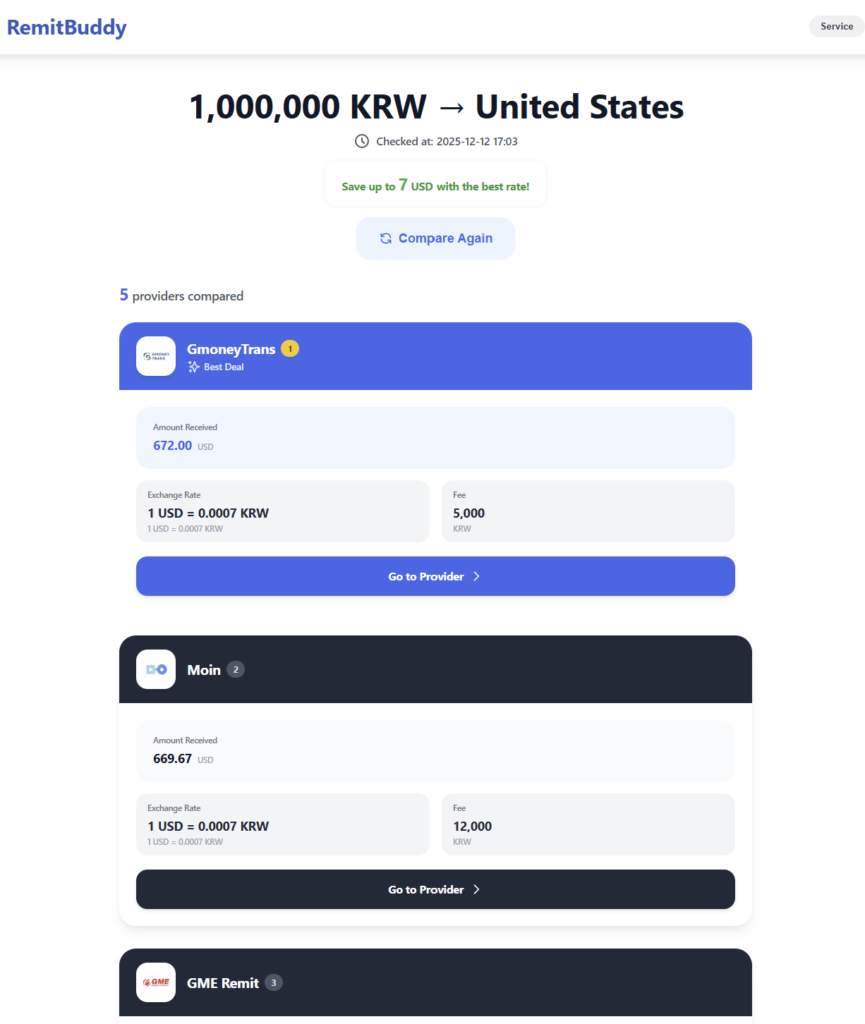
Sending ₩1,000,000 does not mean your family receives the same amount across different services.
Even when everything else seems identical.
Why ₩1,000,000 Is the Perfect Example
₩1,000,000 sits in a realistic middle ground:
- It’s a typical monthly remittance amount
- Exchange rate differences are noticeable
- Fee structures start to matter
- Small percentage gaps turn into visible numbers
In other words, if differences appear here, they’re not theoretical — they’re practical.
What We Compared (And What We Didn’t)
To understand why results differ, let’s simplify the scenario.
We assumed:
- The same sender in Korea
- The same recipient country
- The same sending amount: ₩1,000,000
- The same day
We did not consider:
- Temporary promotions
- Loyalty discounts
- One-time signup benefits
The goal wasn’t to find a “winner,”
but to understand why outcomes change at all.
Same Amount Sent, Different Amounts Received
What we found is something many expats experience without fully noticing:
- One service delivers noticeably more
- Another delivers less — even with a “lower fee”
- The gap can reach tens of thousands of won
Nothing obvious looks wrong on the surface.
You send ₩1,000,000.
The transaction completes normally.
Your family receives the money.
But the final amount is different.
Where the Difference Actually Comes From
Most people assume the difference must come from fees.
That’s only part of the story.
1. Exchange Rate Adjustments
Each service applies its own exchange rate, which may differ from the mid-market rate.
Even a small adjustment — barely noticeable on screen — can outweigh the fee entirely.
2. How Fees Are Applied
Some services deduct fees upfront.
Others build them into the exchange rate.
The result feels similar, but the math isn’t.
3. Rate Timing
Some services lock the rate immediately.
Others apply it later during processing.
That timing difference alone can change the final amount.
Why Most Expats in Korea Miss This
In theory, all this information is available.
In reality:
- Cost details are spread across multiple screens
- Important explanations are often only in Korean
- Each service presents information differently
- Side-by-side comparisons are rare
So most foreigners in Korea never see the full picture at once.
They compare:
- Fees vs fees
instead of - Final amount received vs final amount received
Why the Difference Feels Smaller Than It Is
Let’s say the difference is equivalent to:
- 20 USD
- Or 30 USD
That doesn’t feel like a major loss.
But if you send money from Korea every month, the same gap repeats.
Over time:
- The difference compounds
- The loss becomes structural
- And it quietly becomes “normal”
The Real Lesson From ₩1,000,000
This example isn’t about one service being good or bad.
It shows something more important:
The amount you send from Korea is only the starting point.
The amount your family receives is the real metric.
If you don’t compare that final number, you’re not actually comparing costs at all.
What to Look at Next Time You Send Money
Before your next transfer from Korea, try shifting your focus:
- Don’t just check the fee
- Don’t rely on the Google exchange rate
- Don’t assume similar services produce similar results
Instead, ask one simple question:
“How much will my family actually receive?”
That question explains why ₩1,000,000 can turn into very different outcomes.
Coming next
In the next post, we’ll look at why comparing remittance services in Korea is especially difficult for foreigners — and why most people give up before they get a clear answer.
“Sending Money From Korea: Why ₩1,000,000 Turns Into Different Amounts?”에 대한 1개의 생각