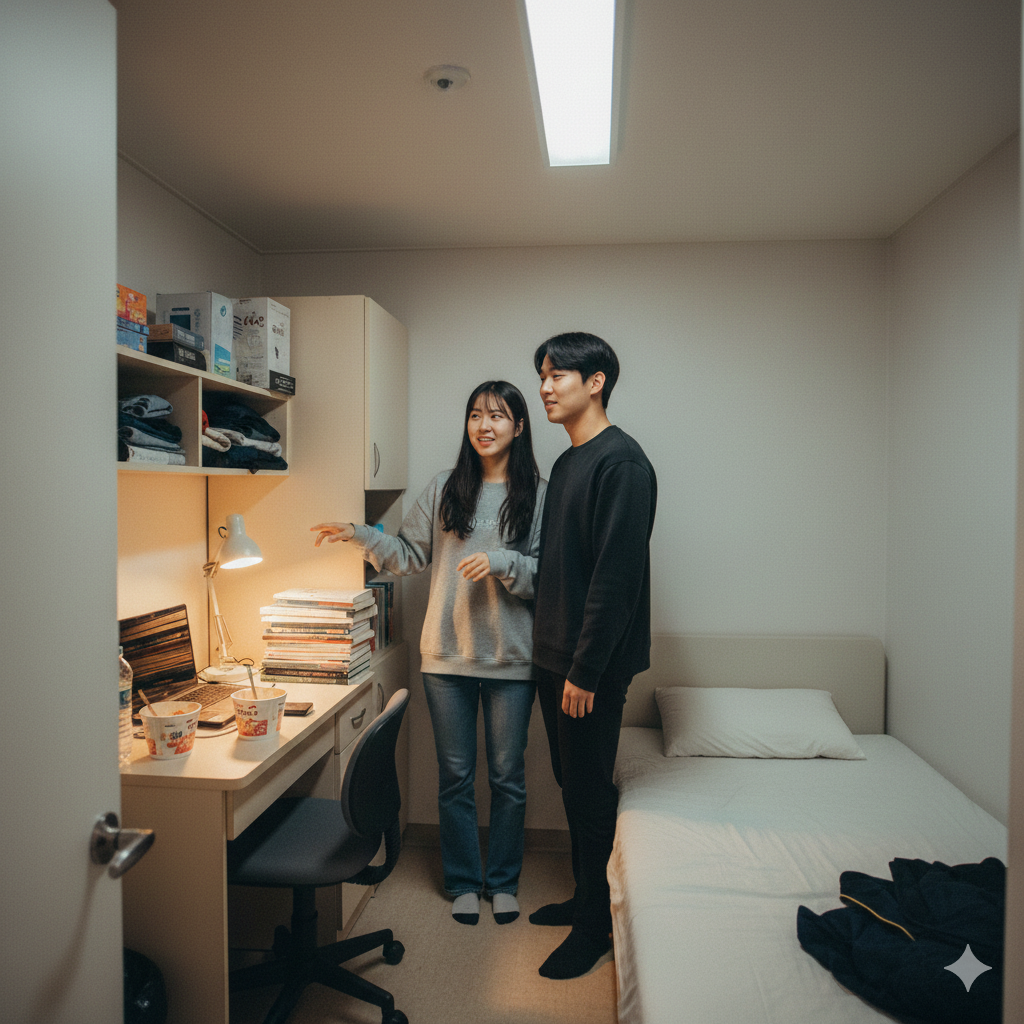
It’s a question that pops up every semester when couples, friends, or budget travelers plan to move to Seoul: can two people actually live together in a goshiwon? I had that exact thought years ago when I first looked at those “tiny room” listings near Sinchon. I imagined squeezing two humans, two suitcases, and maybe one dying plant into a space barely wider than a closet. It sounds absurd… but somehow, people do it.
Let’s talk about what’s actually possible — and what’s probably just a bad idea romanticized on YouTube.
Technically? Yes.
Two people can live in a goshiwon — but only if the place allows it and if you find one of the rare “double rooms.” Most goshiwons are strictly one-person spaces. They’re built for students studying for exams or workers who just need a bed near the subway.
When you see photos online, the rooms usually look bigger than they are. In reality, a single goshiwon room might be 3–7 square meters. That’s roughly the size of a small bathroom in the U.S. You can’t both stand up comfortably unless you take turns.
Still, some goshiwons advertise “twin rooms” or “double rooms.” They’re usually wider, come with two single beds or a small double bed, and sometimes have a private bathroom. These are the unicorns of goshiwon life — more expensive, harder to find, and often booked out months in advance.
I once saw a listing in Gangnam offering a “two-person room” for ₩650,000/month. It looked more like an upgraded storage unit with Wi-Fi. But hey, it existed.
What Goshiwon Owners Actually Allow
Thing is, most goshiwon owners will say “no” if you ask to live as a pair in a single room. It’s not about being strict — it’s about practicality. Two people double the noise, the laundry, the electricity use, and sometimes the complaints from other tenants.
But if you’re upfront and ask for a double-occupancy option, many will accommodate. Some goshiwons near universities (like Hongdae or Hanyang) even advertise shared rooms for couples or friends. They know students split rent to survive Seoul’s brutal housing costs.
One owner I met near Ewha Womans University said she didn’t mind couples as long as they were “quiet and clean.” That was her exact phrasing. She also charged an extra ₩100,000 for the second person “to cover utilities.” Fair enough.
Space, Comfort, and Reality Checks
Let’s be real: two people in a goshiwon is not a glamorous setup. It’s tight, hot in summer, and you’ll bump elbows brushing your teeth.
There’s usually one desk, one wardrobe, one mini-fridge, and maybe a bunk bed if you’re lucky. Private bathrooms help, but ventilation can be weak. If you’re the type who needs personal space or quiet time, it’s going to test your patience — or your relationship.
That said, for short-term stays (a few months), it can actually work. Especially if you’re both minimalists or just saving cash before moving into a one-room apartment. Some expats and language students treat it like camping: not comfortable, but temporary.
I saw one couple on Reddit describe it as “a social experiment in patience.” That feels about right.
How to Find a Double Goshiwon
You won’t find many on English-language housing platforms. The easiest way is to search on Korean sites like:
- 직방 (Zigbang) — look for keywords like “2인실 고시원” (2-person room goshiwon).
- Naver Real Estate (네이버부동산) — sometimes has listings under “원룸텔” (a slightly nicer goshiwon).
- Ask directly. Walk around a neighborhood with lots of goshiwons — Sinchon, Jongno, Konkuk — and check the signs outside. Many have handwritten notices with details about available rooms.
Pro tip: if you’re already in Seoul, you can just walk into a goshiwon building and ask the owner (사장님). They often don’t post their double rooms online.
Price Reality and Alternatives
Expect to pay around ₩600,000–₩800,000/month for a double room in central Seoul. That’s higher than single goshiwon rates (which are more like ₩350,000–₩500,000).
At that point, it’s worth comparing share houses or one-room apartments. Share houses (like Borderless House, Seoulshare, or Ziptoss listings) offer larger spaces and shared kitchens — and they don’t freak out about two people in one room.
Thing is, Seoul’s housing system is weirdly flexible but brutally expensive. The goshiwon remains the cheapest no-deposit option, which is why so many foreigners and students still choose it despite the tiny space.
Cultural Notes (Because Context Matters)
Living as a couple in a goshiwon can raise eyebrows. These places are traditionally quiet study environments. Long-term residents — think grad students, civil service exam takers — value silence and privacy. Two people chatting late or cooking ramen together might get side-eye fast.
Some owners even have written rules against opposite-sex visitors after hours. It’s not personal — just part of goshiwon culture. If you’re a couple, it’s better to look for a “couple room” explicitly. Otherwise, you risk getting asked to move out mid-month.
I knew someone who tried to hide that her boyfriend was staying over. The owner found out after two nights and politely told them to “find a bigger room elsewhere.” Which they did, after a week of awkwardness.
When It Works
There are scenarios where two people living in a goshiwon totally makes sense:
- You’re both students at the same school and need a temporary base.
- You’re digital nomads who just need Wi-Fi and a bed.
- You’re in Seoul for a short-term project or language program.
- You’re trying to save aggressively before moving into a bigger place.
In those cases, a double-occupancy goshiwon can be a brilliant stopgap. You get private space, utilities included, and no need for key money (the dreaded Korean housing deposit).
My Take (After Way Too Much Research)
Honestly, living as two people in a goshiwon is doable — but not sustainable long-term. Think of it as a short chapter, not a lifestyle. It’s great if you’re young, broke, and adaptable. Less great if you like cooking real meals or stretching your arms without hitting a wall.
If you’re adventurous, try it. You’ll have a ridiculous story later. If you’re picky about space or sleep, skip it and find a small officetel instead.
FAQ
Can two people live in a goshiwon legally?
Yes, if the goshiwon allows it. Some offer official double rooms.
Do they charge more for two people?
Almost always. Expect ₩100,000–₩200,000 more per month.
Is it comfortable?
Not really. Think of it as “cozy meets claustrophobic.”
Do all goshiwons have private bathrooms?
No — cheaper ones share bathrooms. Double rooms usually have private ones.
Can couples stay together in a goshiwon?
Yes, but only if the owner allows it. Some forbid mixed-gender occupancy.
What’s the alternative if we need more space?
Share houses or one-room studios are better for couples.
Can I hide that someone else is living with me?
Technically possible, but risky. Most owners will notice quickly.
Do goshiwons require deposits?
Usually no. Just monthly rent upfront.
How long can two people stay in one?
As long as your contract allows — but long-term comfort might suffer.
Is it worth it?
For short stays or tight budgets, yes. For sanity long-term? Probably not.