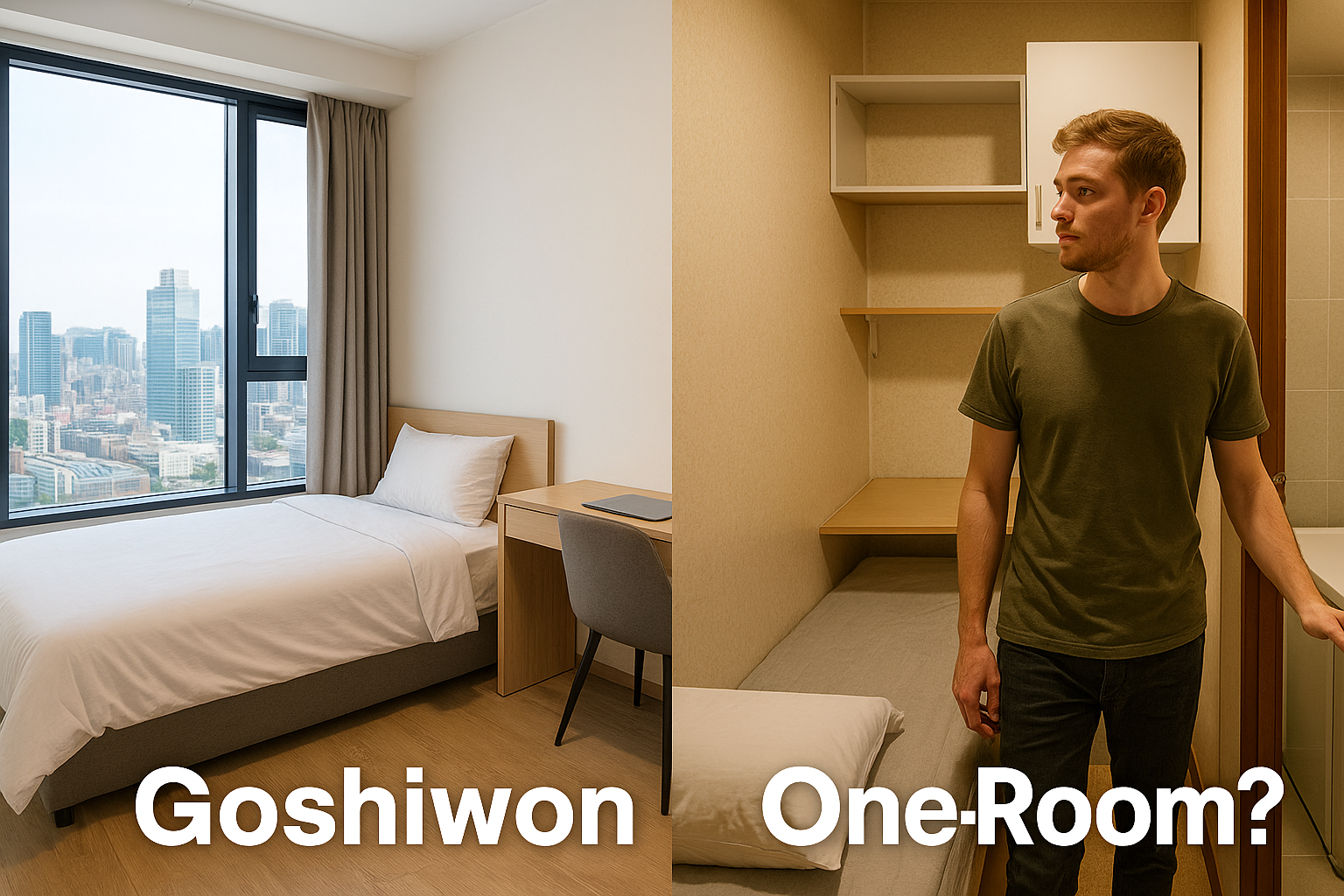
When I first started apartment hunting in Seoul, I had no idea how many layers there were to the whole system. Every listing looked affordable — until I saw the deposit, the management fee, or the fine print that said “bathroom shared with floor.” That was my first encounter with goshiwon and one-room living — two of the most common housing options for students, freelancers, and foreigners.
But what’s actually cheaper when you factor in everything — rent, food, bills, sanity? The answer’s not as straightforward as you might think.
The Upfront Cost Trap
The biggest shock for anyone new to Korea is the deposit system.
For a one-room (원룸), you usually pay a jeonse or wolse deposit. Jeonse means a huge lump sum (like ₩50 million+) that you get back when you move out. Wolse, the normal choice for foreigners, is a smaller deposit plus monthly rent.
Average setup for a one-room in Seoul:
- Deposit: ₩5,000,000 (about $3,800)
- Monthly rent: ₩600,000–₩900,000
- Maintenance fee: ₩50,000–₩100,000
Now compare that to a goshiwon (고시원):
- Deposit: ₩0
- Monthly rent: ₩250,000–₩600,000
- No management fee, and utilities are included.
At first glance, goshiwon looks like the obvious win. But it’s not just about money on paper. There’s a reason people “graduate” from goshiwon to one-room when they can.
Living Costs Beyond Rent
Electricity, Gas, and Heat
One-rooms are like mini houses, so you pay for utilities separately. Winter is where it hurts — Korea’s ondol floor heating eats gas like crazy. One friend in Mapo paid ₩120,000 in January for heating alone.
Goshiwon? Everything’s included. No surprise bills, no guilt about running your heater. But your heater might barely work anyway — some owners limit temperature control to save costs.
Internet and Wi-Fi
Most one-rooms require setting up your own Wi-Fi (₩20,000–₩40,000 per month). Goshiwon always have it pre-installed. Fast? Usually. Stable? Depends on your neighbors’ Netflix habits.
Food and Cooking
This one’s interesting. Many goshiwon include free rice, kimchi, and instant ramen. So you can technically survive on ₩0 food costs if you’re desperate or lazy. Cooking is minimal — shared kitchens, no personal stove.
In a one-room, you have your own kitchen but buy everything yourself. So unless you’re disciplined, your grocery and delivery bills can explode. I once did the math — I spent ₩300,000 on food my first month in a one-room. That’s half a goshiwon’s total rent.
Comfort vs Claustrophobia
Space Reality Check
A standard one-room: 15–25 square meters.
A goshiwon: 3–6 square meters.
If you can’t visualize it, imagine living inside your closet. Then imagine trying to sleep, eat, and work in it. That’s goshiwon life.
You can’t host friends, there’s no wardrobe, and sometimes the “window” faces an indoor hallway. On the plus side, cleaning takes five minutes.
But here’s the weird truth: if you’re just studying, it kinda works. Quiet, minimal, distraction-free — like a monk cell with Wi-Fi.
Privacy and Sound
One-room walls are thin, but goshiwon walls are paper. You’ll hear footsteps, coughing, the occasional existential sigh. Some people say it’s comforting — others say it’s torture.
Duration Changes Everything
If you’re staying less than 3 months, goshiwon wins hands down. No contracts, no paperwork, no deposit risk.
But for 6+ months, the math flips.
Let’s say:
- Goshiwon: ₩500,000 × 6 months = ₩3,000,000
- One-room: ₩800,000 × 6 months = ₩4,800,000 (+₩5,000,000 deposit you get back)
So even though a one-room feels pricier, the deposit isn’t lost. You just need the cash upfront.
Also, some one-room owners lower rent if you sign a longer contract (12 months+). Goshiwon prices rarely change — short-term stays are their business model.
- Moving fees: Goshiwon moves cost nothing; one-room moves usually mean hiring a small truck (₩50,000–₩100,000).
- Furniture: Most goshiwon rooms come fully furnished. One-rooms often don’t — bed, desk, curtains, even fridge can be your problem.
- Cleaning deposit: Some one-room landlords deduct a “cleaning fee” at the end (₩50,000–₩100,000).
- Insurance: You can skip it, but Koreans often buy small accident insurance for apartments.
Who Each Option Fits Best
Goshiwon:
- Language students
- Short-term visitors
- Anyone broke but independent
- People okay with shared spaces
- Minimalists who don’t cook or socialize much
One-Room:
- Workers or long-term expats
- Couples
- People who like control and comfort
- Anyone staying 6+ months
- Those who hate noise and want a door that seals shut
There’s no moral victory here. Goshiwon is survival mode. One-room is investment mode.
Real Example Comparison (2025 Seoul Prices)
| Type | Deposit | Monthly Rent | Utilities | Size | Total 3-Month Cost | Total 6-Month Cost |
|---|---|---|---|---|---|---|
| Goshiwon | ₩0 | ₩450,000 | Included | ~5㎡ | ₩1,350,000 | ₩2,700,000 |
| One-Room | ₩5,000,000 | ₩800,000 | ₩80,000 | ~20㎡ | ₩2,640,000 | ₩4,880,000 |
| One-Roomtel (Deluxe Goshiwon) | ₩1,000,000 | ₩650,000 | Included | ~9㎡ | ₩1,950,000 | ₩3,900,000 |
Note: deposits are refundable except for cleaning or damages. Prices vary wildly by area — Hongdae is not the same as Incheon.
The Emotional Cost Nobody Mentions
Numbers aside, there’s a mental difference between surviving and living.
In goshiwon, days blur together. You eat in silence, sleep in silence, and sometimes feel invisible. One-room life brings its own loneliness, sure — but at least it’s a loneliness you decorate with plants and fairy lights.
That said, not everyone can (or should) rush into a one-room. Sometimes a few months in a goshiwon helps you adjust to the city before locking into something bigger.
So if you’re new in Korea: start cheap, save up, move up. That’s how most locals do it anyway.
FAQ
Which is cheaper overall, goshiwon or one-room?
Short-term: goshiwon. Long-term: one-room, since deposits are refundable.
Are goshiwon safe?
Mostly, yes — but always check for fire exits and sprinklers. Older ones can be risky.
Do one-rooms include furniture?
Sometimes. Newer ones do, but many come empty.
Can foreigners rent one-rooms easily?
Yes, but you might need a Korean bank account or guarantor.
Is it noisy in goshiwon?
Very. You’ll hear everything.
Why not just use Airbnbs?
Because long-term Airbnb rentals cost 2–3x more and rarely include utilities.
Are there female-only goshiwon?
Yes, many. They’re safer and often cleaner too.
I don’t know — can you live happily in a goshiwon?
Depends. Some love the simplicity. Others lose their minds.
“Goshiwon or One-Room? Full Cost Comparison”에 대한 2개의 생각