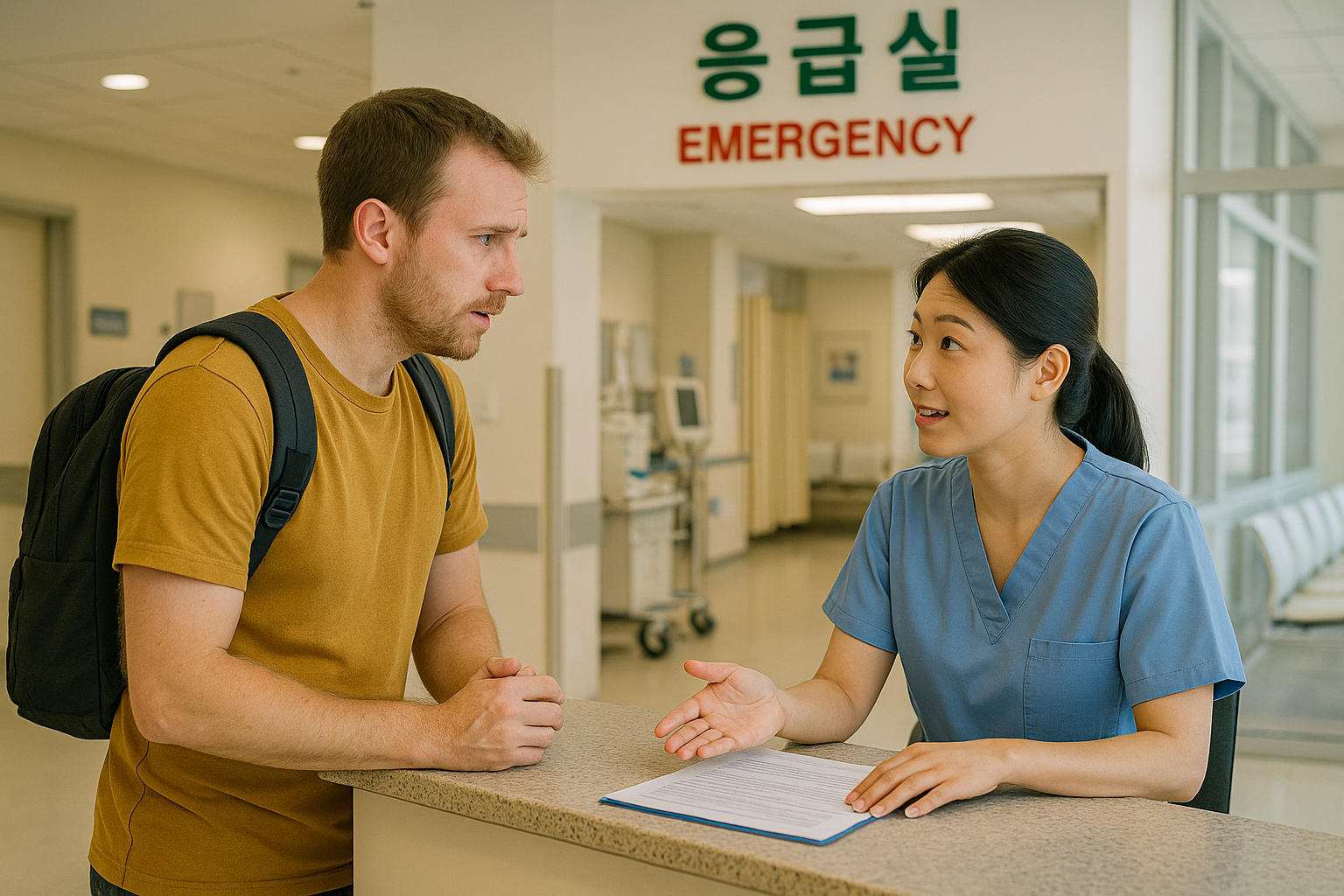
I didn’t plan to stumble into this topic at midnight, but I got sucked into a thread where someone in Daegu said they went to the ER with zero insurance and walked out with a bill “around 200k-ish,” while another guy in Seoul claimed he paid almost a million won for what sounded like the exact same symptoms. That’s the kind of contradiction that makes you wonder if Korean hospitals operate in parallel universes. Maybe they do. Or maybe the people telling the stories forgot half the details. I couldn’t sort out every inconsistency, and honestly I stopped trying.
What I kept noticing, though, was this tension between Korea’s ultra-efficient medical system and the weird high-risk feeling you get when you’re uninsured. It’s not fear of the medical part — Korean ERs are incredibly good — but the uncertainty of not knowing whether you’re about to spend 150k or basically your whole trip budget in one sitting. I guess that’s what pulled me into writing about it: not to deliver a neat guide, but to make sense of the gaps, the odd anecdotes, and the moments where even locals shrug and go, “Well… it depends.”
What Actually Happens When You Walk Into a Korean ER Without Insurance
The first thing that surprised me — and this came up repeatedly — is that Korean ERs do not turn you away for lack of insurance. They just don’t. Legally, ethically, culturally, all the systems are built around treating you first. But having no insurance makes the process slightly… different. Not dramatically, more like a subtle shift in tone that you only notice if you pay attention.
One detail I ran into: some hospitals do quick pre-checks when you don’t have insurance. Not to demand payment upfront, but to make sure you’re identifiable and reachable. A few people said staff asked something like “passport copy?” or “local contact?” while others weren’t asked anything at all. So it’s not standardized. One nurse apparently told a traveler that uninsured foreigners often leave the country without paying, which creates extra paperwork. I couldn’t confirm that, but it kinda sounded plausible.
Then there’s the triage process. It’s fast, usually. A traveler from Canada said he was seen within five minutes. Meanwhile, a woman in Busan claimed she waited 90 minutes because the ER was verifying her information. That sounded exaggerated to me, but someone else described a similar delay. I don’t know if that’s a coincidence or a bureaucratic hiccup.
But the actual treatment? Surprisingly thorough. Maybe too thorough. Doctors in Korea tend toward testing rather aggressively — blood panels, imaging, sometimes even repeat scans. It’s not overkill in a malicious way; the culture here just leans toward eliminating risk quickly. That’s great when you’re insured. Without insurance, it becomes the core of your anxiety, because you never know whether the next suggestion is “let’s check something minor” or “let’s run a CT just in case.”
Some hospitals apparently mention cost ranges before tests, but many don’t. You’re expected to trust the process, which is fine until you realize every test is a separate line item that doubles or triples your total. The ER fee alone sits somewhere in the 100k–200k range for uninsured patients, and that’s before anything else is added. Locals rarely pay this much because insurance eats most of it. Foreigners without insurance get the raw price, which feels like discovering the “real menu” behind the discounted menu Koreans see.
Another small but recurring pattern: interpretation fees. Some hospitals add them. Some don’t. Some add them even if you barely used the interpreter. I couldn’t pin down a rule, and that inconsistency is annoying in a way only bureaucracy can be.
The Strange Cost Variables Nobody Tells You About
I got stuck trying to decode why two uninsured travelers could walk into similar ERs with similar symptoms and walk out with hilariously different bills. At first I thought maybe Seoul is always pricier, but that wasn’t true — someone in Jeju paid nearly 800k for a head CT, while someone in Seoul paid less than half that. So scratch that theory.
The real variables were more obscure:
Korea has a loose three-level structure: giant university hospitals, mid-sized general hospitals, and smaller local hospitals. The bigger the institution, the bigger the bill. Easy enough. But travelers — especially uninsured ones — tend to run straight to the big hospitals because they feel safer. Understandable. But that safety has a price tag that escalates quietly.
H3 The Doctor’s Personality (yes, seriously)
This one caught me off guard. Someone wrote that one doctor ordered minimal tests, while another with the same symptoms ordered “everything they could think of.” Medicine shouldn’t depend on personalities, but in subtle ways it kinda does. Some doctors play it cautious, others trust clinical instinct. And uninsured foreigners sometimes get the cautious type.
H3 Nighttime & Holiday Fees
These exist, and they vary. That’s the annoying part. One guy in Incheon paid an extra 20k-ish. Another was charged more than 100k at a university hospital. It reminded me of the way restaurants add “weekend prices,” except this involves your organs.
H3 The Fear Factor
Uninsured patients tend to say yes to everything out of fear — fear of miscommunication, fear of misdiagnosis, fear of dying alone at 2 a.m. in a foreign country. And doctors, trying to help, interpret that fear as urgency. Urgency leads to more tests. More tests lead to higher bills. A weird circular loop powered by anxiety.
H3 Coding (the insurance-reimbursement puzzle piece you don’t think about)
Even if you plan to submit your receipt to travel insurance later, the diagnostic coding matters. Some travelers said they were denied reimbursements because the code the hospital used was too vague. One person said dizziness was coded “unspecified,” and their insurer refused. This is one of those deep administrative rabbit holes I don’t fully understand but can confirm is real enough to ruin someone’s week.
The more I researched, the more I realized costs are like a Korean side dish assortment: you don’t choose them individually; they just appear.
What Uninsured Travelers Can Actually Do (Even if Nobody Tells You This Directly)
This isn’t advice so much as a collection of tactics people claimed worked for them. Some sound reasonable. Some sound like hacks that probably shouldn’t work but apparently do.
For example, a traveler said they asked the doctor directly, “Is that test absolutely necessary?” and the doctor paused, reconsidered, and canceled the CT order. That seems huge. Meanwhile someone else said the doctor insisted the CT was essential even though their symptoms sounded minor. So it really depends on the doctor.
Another tip: choosing a smaller general hospital instead of a massive university hospital. It doesn’t always save money — sometimes the smaller places order weirdly large panels of tests — but many people reported bills as low as 120k–250k won when avoiding the big institutions.
But you need to be okay with minimal English support if you choose a smaller hospital. One person said their doctor used Google Translate the entire time. They still got treated, but the whole experience sounded like wandering into a medical escape room.
Something else that came up more often than I expected: bringing a Korean-speaking friend reduces confusion and sometimes reduces unnecessary test orders. Not because anyone is trying to scam you — more like the doctor feels more confident communicating risks and therefore doesn’t rely on defensive testing.
And then there’s the option almost nobody mentions: urgent care clinics. Korea separates them differently from Western countries, so they’re not always obvious. Some severe-looking symptoms actually go to “nighttime clinics” instead of ERs. They’re cheaper, though not as comprehensive. A few travelers said these saved them from paying ER-level rates for mild problems like food poisoning or dehydration.
A weird tangent I stumbled across: someone wondered whether hospitals charge foreigners more because they assume they can’t return to dispute the bills. I couldn’t confirm that at all. It sounded like paranoia mixed with one bad experience. Still, an interesting psychological theory to stick in your back pocket.
But the real truth? Being uninsured in Korea shifts everything. The system still works, but it stops feeling seamless. You become painfully aware of every decision, every form, every test suggestion. Locals speak casually about cheap healthcare because they’re seeing the insured prices. Uninsured people live in the raw-data version of the system.
If there’s a silver lining, it’s that even the high bills in Korea are still lower than ER costs in a lot of Western countries. Not comforting when you’re the one paying, but still relevant.
FAQ Section
Can I visit any ER without insurance?
Yes. They won’t reject you.
How much will it cost?
I wish I knew. The range is ridiculous.
Cheapest option?
Smaller general hospitals or nighttime clinics.
Do ERs ask for payment upfront?
Not usually, though a few exceptions popped up.
Can I refuse tests?
Yes, but you might need to say it clearly.
Are doctors okay with that?
Depends entirely on the doctor.
Can travel insurance reimburse later?
Sometimes. Coding errors ruin it often.
Should I avoid big hospitals?
If you’re uninsured and cost-sensitive, maybe.
Why do some bills include interpretation fees?
Because some hospitals treat it as a service, even if brief.
Unrelated question: why do Korean hospitals love CT scans?
No idea. Possibly convenience mixed with caution.