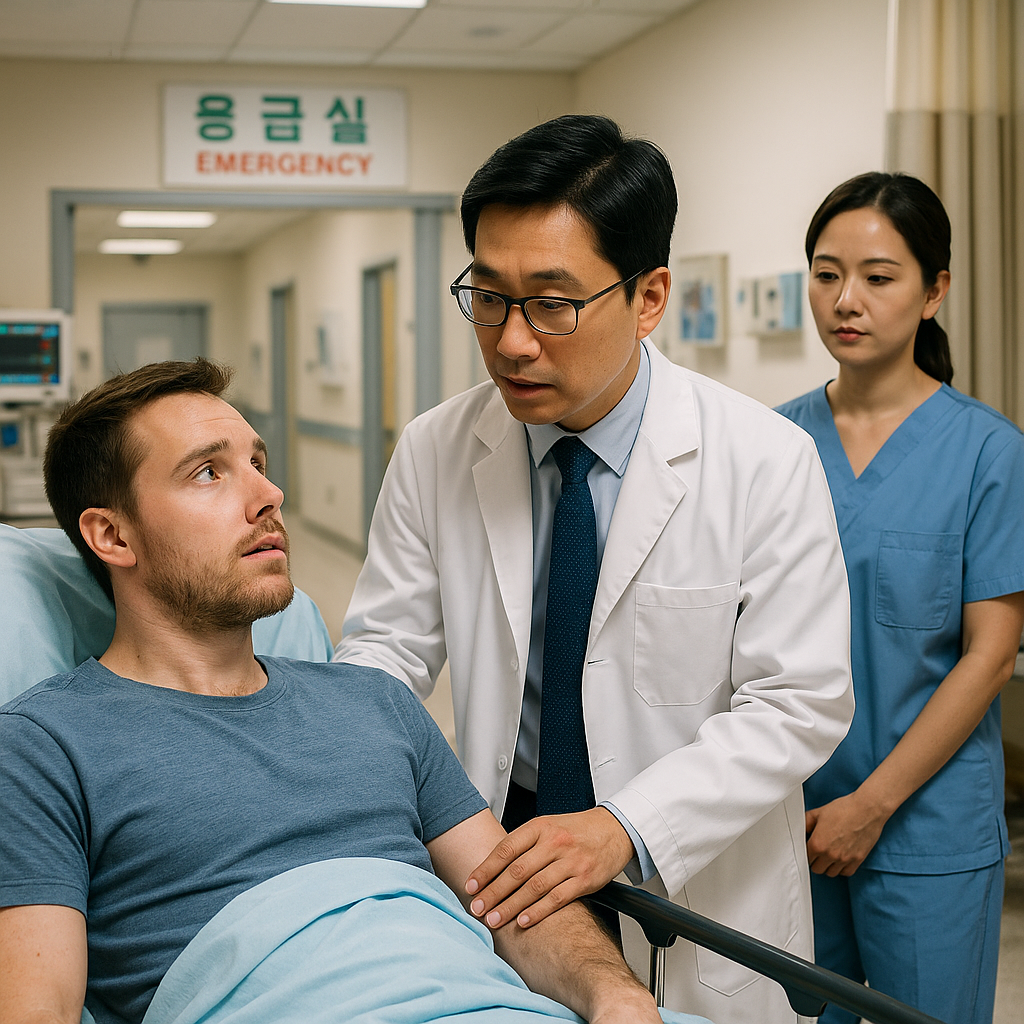
I didn’t expect to spend half a night reading random posts from medical forums and then some random Reddit threads, but that’s kinda what happened. One guy claimed he paid “maybe 40 bucks?” for an ER visit in Busan, another swore the same hospital charged him nearly 600k won for basically nothing. That kind of contradiction usually annoys me, but here it actually helped me realize something: you can’t really predict how the medical system treats foreigners until you see the mess of personal stories behind the numbers. And Korea’s system, for all its efficiency, still has these weird pockets of unpredictability that make you go, “Wait, what?”
I’m not trying to write some polished medical guide. More like sorting through the half-confirmed info, the anecdotes, the stuff that felt plausible, and my own confusion, hoping someone else might find a thread that makes them go, “yeah okay, that actually makes sense.” And if it doesn’t? Well, at least it won’t read like a robotic brochure.
How the Korean ER System Actually Feels When You’re Not a Local
The funny thing about emergency rooms in Korea is that they’re wildly efficient compared to a lot of countries, yet the experience feels slightly alien if you’re not used to the flow. And by “flow,” I mean that subtle pressure to follow a system that’s extremely organized but not necessarily transparent.
I remember seeing a comment from someone who said they waited only ten minutes before getting triaged, which honestly sounds magical if you’re used to four-hour waits in other places. But someone else wrote they waited nearly two hours, not because the ER was crowded but because the staff needed to verify their passport details and confirm they could be billed. I couldn’t verify whether that’s actually common or just unlucky. Maybe both.
Thing is, Korea’s public attitude toward healthcare is very much “get in, get fixed, get out,” which is refreshing until you realize you don’t know what you’re being charged for until you’re already halfway through the process. There’s this moment — it usually hits near the discharge desk — when a foreign traveler sees their itemized list and wonders whether the doctor really needed that test or that injection. Sometimes they did. Sometimes they probably didn’t. It’s tricky.
And ER rooms aren’t cheap if you’re not under Korea’s national insurance system. I kept trying to find an exact average cost, but the numbers varied so much it became laughable. One source tossed around “150k–300k won,” another said “400k-ish,” and someone else claimed the ER bill rarely goes above a million unless something major happens. Actually, that wasn’t accurate — I later found a different post where someone paid nearly 2 million after CT scans and IV meds. So you see the chaos.
But what’s interesting is how Korean hospitals rely on a tiered model. Bigger university hospitals tend to be pricier. Smaller general hospitals may be cheaper but sometimes slower. Foreigners usually drift toward the bigger ones because they feel safer, especially with language support, but that comes with larger bills. And those bills stack in unexpected ways: facility fee, doctor’s fee, equipment fee, testing fee, medication, sometimes an “after-hours” fee. It adds up, even if each item by itself doesn’t look terrible.
Another thing nobody told me until recently — the ER fee itself is unavoidable, whether they treat you for ten minutes or ten hours. And as a non-Korean, you pay the full amount. That feels obvious now, but I sorta had the wrong impression that “ER basics” were cheap everywhere. Not here. Not for travelers.
Random Factors That Make Costs Jump (Even When They Shouldn’t)
I went down this weird rabbit hole trying to figure out why two foreigners with the same symptoms could pay drastically different amounts, and honestly the explanations weren’t satisfying. Or consistent. But maybe that’s what makes it human enough to talk about.
For starters, doctors love tests. Not because they’re greedy — most of the time they’re genuinely concerned — but because Korea’s medical culture leans toward ruling things out quickly. So if you walk in saying “I feel dizzy,” you might expect a basic blood test, but you could end up with an EKG and a CT scan. Someone once wrote that they were given a CT “just in case it was a brain thing,” even though they only fainted from dehydration. Could be exaggerated, but still believable.
Some hospitals also ask about travel insurance at the start. This is where the whole situation becomes unpredictable. If you mention insurance, some people swear that hospitals become more generous with test orders. I don’t know if that’s true — it kinda sounds like an old rumor — but enough stories hinted at it that I can’t dismiss it entirely.
And then there’s the language thing. I’ve seen people claim they were charged for interpretation services even when they didn’t ask for them. One person insisted they didn’t use the interpreter at all. Someone else said the interpreter never left their side. I can’t tell who was right; probably both depending on the hospital.
But here’s a detail that surprised me: nighttime surcharges. They exist, though not everywhere. And sometimes it’s not listed clearly upfront. A traveler in Incheon wrote that their late-night visit cost them “an extra 30k-ish,” which sounded small until I saw someone else mention over 100k added at a larger Seoul hospital. Maybe they exaggerated. Or maybe different hospitals treat “nighttime” as “premium time.” Who knows.
Actually, I should correct something — not every hospital charges separately for nighttime hours. The smaller clinics might not. But the bigger institutions? They definitely do, from what I could gather. And foreign travelers almost always end up in those places, so that’s that.
One more odd detail: ER doctors in Korea often switch quickly between patients. The upside is you’re seen faster. The downside is you have less time to ask questions, meaning you might not realize what tests are being ordered until they’re already happening. That short interaction window can lead to bills that feel like they came out of nowhere.
And honestly, some travelers panic and say yes to everything the doctor suggests because they’re scared, and that’s how bills escalate. Not blaming them — I’d probably do the same. But it’s worth acknowledging that fear can be an indirect cost factor.
The Part Nobody Mentions: How Being a Foreigner Changes Your Options
What struck me the most while reading through all these stories was how being a foreign traveler quietly shifts everything: the process, the speed, the assumptions nurses make about you, even the price of basic services. Korea doesn’t do it maliciously; it’s just a system built for insured locals. Everyone else feels like an exception floating around the edges.
For one, you rarely get the discounted national insurance rates. That alone doubles or triples costs instantly. And it’s easy to forget that locals almost never pay full price, so when a Korean tells you “ER visits are cheap,” they mean for them. Travelers live in a different price universe.
I kept noticing another pattern: foreign travelers are routed toward international clinics or English-speaking staff, even when they don’t ask for it. That can be helpful, obviously, but also leads to a weirdly elevated experience. More attention, more time, maybe more tests. Some people appreciate it; others find it excessive.
There’s also this thing about documentation. Koreans carry their ID card and insurance info everywhere. Foreigners don’t. That gap creates tiny bureaucratic delays that can stretch into extra evaluation time, extra questions, sometimes even extra fees. A nurse might ask repeated questions simply because they’re required to enter data differently for you.
And then there’s insurance reimbursement. Travelers often assume insurance will cover everything, but sometimes it doesn’t if the doctor assigns a diagnostic code the insurer doesn’t like. This comes up surprisingly often: stomach pain coded as “unspecified,” dizziness coded too broadly, injuries coded without mechanism details. These tiny coding quirks turn clean reimbursements into messy disputes.
Oddly enough, some travelers avoid big hospitals because of this, choosing smaller ERs that feel more “local.” And yeah, those can be cheaper. But also scarier if you’re not confident in the staff’s English ability. Someone mentioned wandering into a tiny hospital in Jeju where the doctor communicated through Google Translate and guessed the diagnosis. They still charged around 120k won, which wasn’t awful, but the whole experience felt like walking into a medical side quest.
A tangent — I saw a thread where someone argued that Korea should offer short-term insurance for tourists. Others said that would attract too many medical tourists and overload the system. I don’t know who’s right. Maybe both.
But the main point is that being a foreign traveler puts you in this hybrid zone where you receive excellent care but not the financial protection locals get. That tension shows up in almost every story I found.
FAQ
Why are costs so different between hospitals?
Because hospital tiers vary wildly, and so do test habits. Also, travelers don’t get subsidized rates.
Do Korean ERs refuse patients without insurance?
No, but they might take longer to process you.
Average ER bill?
Honestly, I don’t know. The numbers contradict each other too much.
Do small hospitals charge less?
Usually, though not always. Some small places order weirdly excessive tests.
Can I avoid CT scans?
Yes, but you may need to say it firmly. Doctors default to caution.
Do they speak English?
Bigger hospitals yes, others kinda… sometimes… not really.
What about medication costs?
Meds are usually cheap, except when injections or special treatments are involved.
Is the ER the same as urgent care?
Nope. Korea separates them differently.
Do I pay before treatment?
Not usually, unless it’s something expensive. But it can vary.
Random question: why are Korean hospital lights so bright?
No clue. Maybe they like clarity. Or LEDs were on sale.