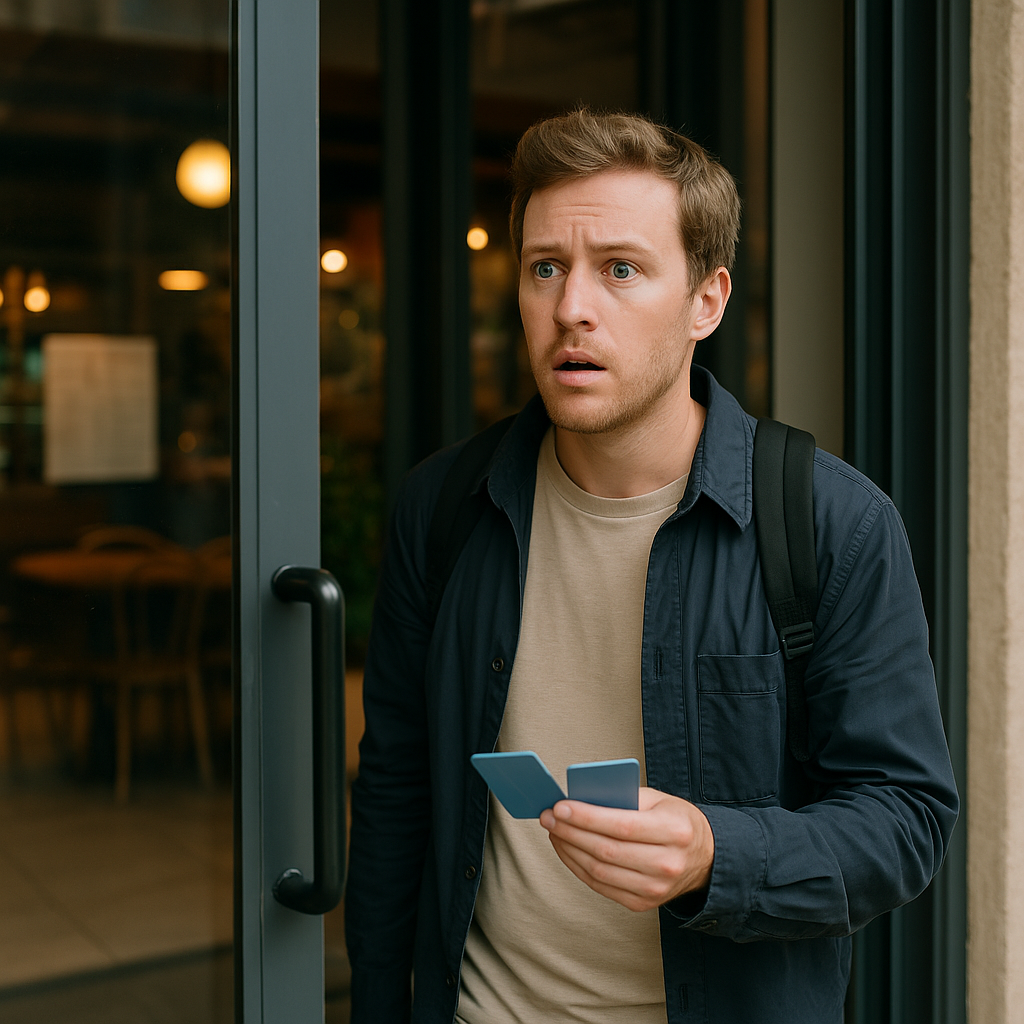
The first time I visited Seoul, someone let a heavy glass door slam shut right in my face. Not on purpose — they just didn’t even look back. I remember thinking, “Wow, that was rude.” But a few weeks later, I caught myself doing the exact same thing. It’s not rudeness. It’s culture. And understanding why Koreans don’t hold doors open actually tells you a lot about how this society works.
Holding doors open seems universal — a tiny act of courtesy drilled into Western etiquette. But Korea operates on a different wavelength: speed and non-interference.
Thing is, Korean social behavior is built around not getting in anyone’s way. If you look closely, the same logic applies on subways, sidewalks, even escalators. Everyone’s moving quickly, with minimal interaction. Efficiency trumps micro-gestures.
Holding the door — even for a second — disrupts that flow. It breaks the rhythm of movement. You stop, the next person slows down, and now there’s a tiny human bottleneck. Koreans unconsciously avoid that.
And honestly, in a country where every door is spring-loaded and every crowd’s on a timer, that instinct kinda makes sense.
A Matter of Intent, Not Manners
To an outsider, it can feel cold. But in Korean culture, politeness doesn’t look the same as in the West.
Western manners focus on visible acts of kindness — smiling, saying “thank you,” small gestures like holding doors or making eye contact. Korean manners emphasize non-disturbance — moving smoothly, speaking softly, not creating friction in shared spaces.
So while someone not holding a door might feel impolite to a foreigner, to a Korean, forcing that social exchange can actually feel awkward.
I once asked a Korean friend about it. She said, “If I hold the door and you’re far away, you’ll feel rushed. That’s more rude.” It’s a subtle but fascinating reversal — courtesy through invisibility.
The Architecture Problem Nobody Talks About
It’s also partly mechanical. Korea’s doors are heavy.
Many buildings use double glass doors with hydraulic closers — the kind that slam if you don’t push hard enough. These are designed for insulation and safety, not courtesy. Holding one open requires real effort.
And it’s not just offices or cafes. Even subway exits have automatic doors that resist manual control. Sometimes you literally can’t hold them — they’ll just slide shut automatically once the sensor resets.
Add to that Korea’s obsession with air conditioning (and keeping it inside), and you get another practical reason: people don’t want cold or warm air escaping.
There’s even signage in some shops: “문 닫아주세요” (“Please close the door”). That says it all.
Another layer to this: space in Korea is social, not personal. In dense environments, people form temporary, self-contained “bubbles” — subway crowds, cafe lines, building entrances. Everyone just focuses on their own path through it.
When someone exits before you, they’re not ignoring you; they’re exiting their bubble. Once they’re out, they’re no longer part of your shared space. So the idea of holding the door doesn’t even register.
Compare that with Western “micro-interaction culture,” where strangers briefly acknowledge each other with small talk, smiles, or gestures. Korea skips all that. It’s not cold — it’s just frictionless.
I couldn’t find hard data on this, but anecdotal evidence from expats matches perfectly. Door holding is simply not a social expectation.
Exceptions: When Koreans Do Hold Doors
Now, to be fair, it’s not like Koreans never hold doors. They just do it differently.
You’ll often see people hold doors open for groups they’re part of — friends, coworkers, or elders. It’s more hierarchical than random. The younger person usually goes last, holding the door for seniors or higher-ranking colleagues.
So, context matters. Inside established relationships, the same gesture carries respect. But between strangers? It’s not part of the social code.
That distinction — insider vs. outsider — runs deep in Korean behavior. Even language reflects it: polite speech (존댓말) is used differently depending on who’s in your circle. Courtesy is relational, not universal.
The Efficiency Obsession
Here’s the thing about Korean urban life: it runs like a machine. Every movement is optimized. People walk fast, escalators have “standing” and “walking” sides, and crosswalks give you exactly 17 seconds.
In that context, even a small gesture like holding the door feels inefficient. People are conditioned to keep moving.
I once timed how long subway gates stayed open — about 1.5 seconds. It’s almost symbolic. Korea’s infrastructure itself reinforces motion over pause.
So it’s not that Koreans lack courtesy — they just express it through not interfering. A clean, predictable flow of behavior is the politeness.
Foreign Reactions and Cultural Whiplash
Most Western expats experience this small shock early on. The first few times it happens, you take it personally. Then you realize nobody’s being rude — they’re just following the local script.
Interestingly, Koreans who travel abroad often feel the reverse. They find it uncomfortable when strangers hold doors or make small talk. It violates the invisible social boundary they’re used to.
One Korean friend told me, “When someone holds the door for me in America, I feel like I have to hurry or thank them loudly. It’s too much pressure.”
That right there sums it up: Korean etiquette aims to remove pressure, not add it.
What You Can Learn From It
After a while, you start appreciating the logic. Everyone moves faster, interactions are cleaner, and you stop expecting micro-validations from strangers.
And ironically, once you stop expecting someone to hold the door, the rare times they do — it hits differently. It feels genuine, not habitual.
That’s kind of beautiful in its own way.
So if you visit Korea and someone lets the door close, don’t take it as a slight. They’re not ignoring you. They’re just letting the world move smoothly — as it always does here.
FAQ
Is not holding doors in Korea considered rude?
No. It’s not seen as impolite — just unnecessary between strangers.
Do Koreans hold doors for elders?
Yes, especially in formal or family contexts. Age hierarchy changes everything.
What about automatic doors?
Most modern buildings have them. They close automatically anyway.
Can foreigners hold doors open?
Sure. People might smile politely or just walk through without reaction.
Do Koreans hold elevator doors?
Yes, more often than manual ones. It’s easier and doesn’t break flow.
Does this apply to the countryside too?
Less so. Smaller towns are more relaxed, and you’ll see more traditional gestures.
Unrelated — why do Koreans walk so fast?
Efficiency. Urban life moves at high speed, and everyone adapts to it.
Do people ever get annoyed if you hold a door?
Sometimes. They might feel awkward or obligated to rush.
Is it changing with younger generations?
Maybe slightly — global exposure is blending habits. But not dramatically.
Would it be rude if I didn’t hold the door for someone elderly?
Depends. If you clearly see an elder right behind you, it’s polite to do so — but still not a strict rule.