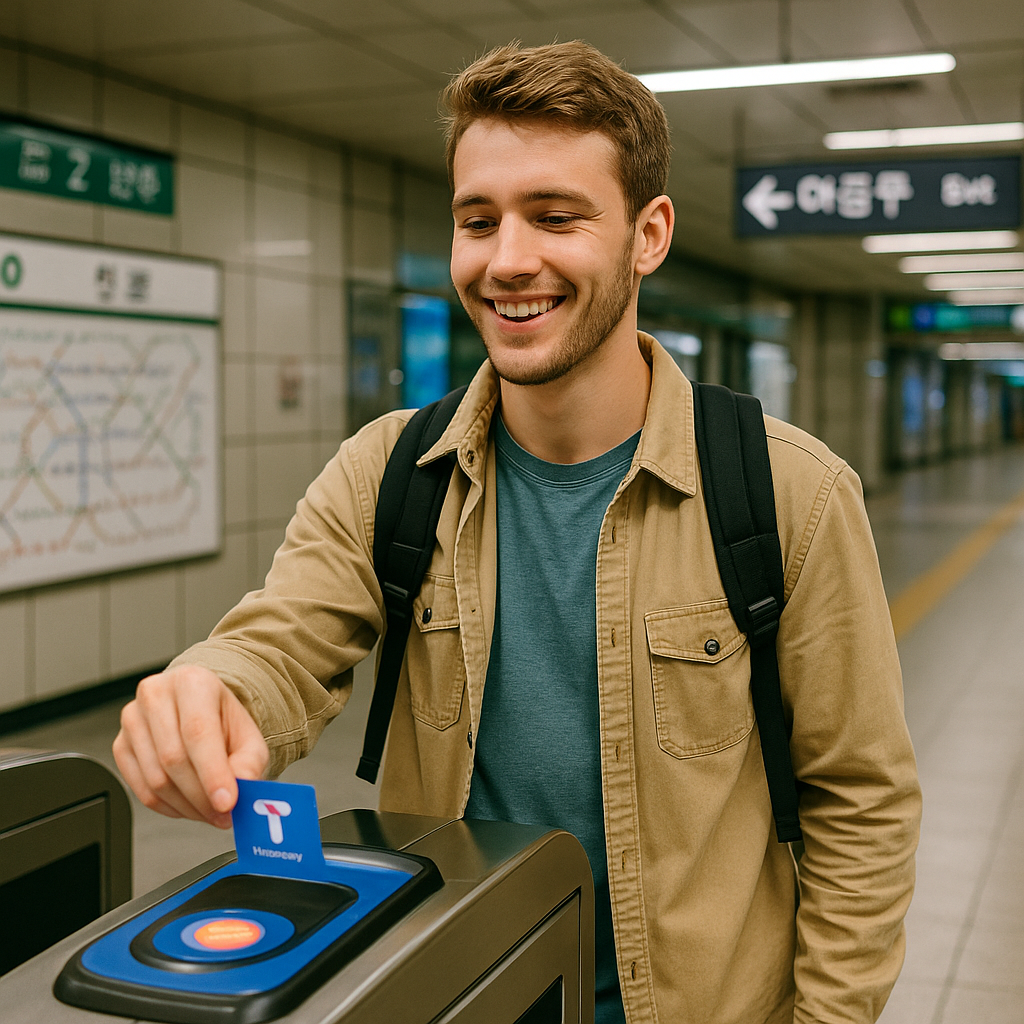
If you’ve ever stood in front of a Korean subway gate, watching locals breeze through with a tiny beep while you fumble for coins, you’ve already met the invisible power of the T-Money card. It’s not just a transit card — it’s a weirdly convenient slice of Korean efficiency. But there’s more to it than just riding the bus.
The Basic Idea Behind T-Money
So, a T-Money card is basically Korea’s universal stored-value transportation card. You tap it on buses, subways, taxis, even some convenience stores. It’s rechargeable, reusable, and accepted pretty much everywhere public transport goes.
What’s fascinating is how invisible it feels once you start using it. No one stops to think about fares — you just tap and move. The balance quietly adjusts. You reload it through machines or over the counter at CU, 7-Eleven, GS25 — all those glowing convenience stores that never sleep.
Actually, “T-Money” isn’t just one card. There’s a whole ecosystem. Seoul introduced it in 2004 to replace the older paper-based bus tickets, but now you’ve got mini keychains, phone cases with embedded chips, even SIM cards for tourists with T-Money functions built-in.
And it’s not only Seoul. The same card works in Busan, Daegu, Incheon, and a bunch of smaller cities. Though, to be honest, the exact discount system can vary. I couldn’t confirm whether the same transfer discounts apply everywhere — some Reddit threads claimed they don’t.
How It Actually Works (and Why It Rarely Fails)
The tech is NFC-based, meaning it communicates wirelessly when you tap it. But unlike Apple Pay or Google Pay, it’s fully offline. The card holds your balance locally, so even if your phone’s dead or there’s no internet, you’re fine.
And the speed is freaky. One tap, less than half a second, gate opens. I read that Korean turnstiles are calibrated for around 0.3 seconds per scan, which explains why rush hour crowds flow like water.
Reloading is simple: machines in subway stations let you top up using cash (usually ₩1,000 to ₩90,000). Some apps now let you recharge with a credit card, though foreigners sometimes hit card verification issues.
Thing is, the system’s reliability comes from how decentralized it is. Each gate or terminal handles the transaction locally — no server bottleneck. If one goes down, others keep working. It’s one of those quiet design choices that makes city life smoother without anyone noticing.
Beyond Transportation — The Unexpected Uses
Here’s where it gets interesting. T-Money isn’t just for transit anymore. You can use it to buy coffee, snacks, or even a McDonald’s meal. Convenience stores like CU and GS25 display the logo everywhere, and the cashier just taps it like a credit card.
Actually, this small payment feature turned out to be huge for students and younger folks who don’t carry cards. It’s a way to manage micro-purchases without worrying about overspending. Some parents even load allowances onto their kids’ T-Money cards.
There’s also a digital version. If you have a Korean SIM, you can install the “T-Money” app and link it to your phone’s NFC chip. It works similarly to Apple Pay but is tied to Korean transit data systems. Ironically, if you’re using a foreign phone, you might be blocked from using it — a minor frustration for expats.
Oh, and one weird thing: even though the name is T-Money, it’s not directly tied to the Korean won in a banking sense. You can’t withdraw the balance or transfer it back to your account. It’s more like a prepaid island of cash that only exists within its own ecosystem.
Where to Buy and Which Version to Get
If you’re visiting Korea, the easiest way is at Incheon Airport — there’s a convenience store near the subway entrance selling cards for around ₩4,000 (empty, no balance). You can then top up whatever you need.
Tourists often debate whether to buy a T-Money card or the “Cashbee” card. Both work similarly, but T-Money tends to have wider coverage, especially in Seoul and Gyeonggi areas. Some say Cashbee reload machines are less common — can’t confirm that firsthand, though.
Also, there are cute branded versions — Kakao Friends, BT21, even Pokémon designs. They cost a bit more, maybe ₩6,000 or ₩8,000, but make for a fun souvenir. Just don’t lose it, since it’s anonymous. No refunds without the card in hand.
One underrated feature: free transfer discounts. If you tap off one bus and board another (or enter a subway) within 30 minutes, the system automatically adjusts so you’re not double charged. You don’t even notice it happening, but it saves a few thousand won daily for commuters.
What’s wild is how much the T-Money card says about Korea itself. Efficiency, design simplicity, tech embedded into daily life — but quietly. No one brags about it.
In a way, it’s like the country’s personality wrapped in plastic. It doesn’t shout innovation, it just works. Tourists often leave impressed without realizing they’ve been part of a massive data-driven logistics network. Every tap generates movement data, used later to optimize bus routes and subway schedules.
And yeah, there are privacy concerns. I found a 2021 article about how Seoul city anonymizes but still aggregates billions of transit data points per year. Technically safe, but still a bit unsettling if you think about how precisely they can track urban movement.
Still, it’s one of those systems where convenience outweighs discomfort. Most people just shrug and tap. That’s kind of the Korean way — practicality first.
FAQ
How much does a T-Money card cost?
Usually around ₩2,500–₩4,000, depending on the design. No balance included.
Can I refund the balance?
Yes, but only at certain convenience stores or service centers. Small fees might apply.
Does it work in Busan or Jeju?
Busan yes, Jeju mostly no. Some taxis accept it, but buses don’t always.
Can foreigners buy or use it easily?
Absolutely. No ID or registration needed. Just buy, load, and tap.
Is T-Money better than Cashbee?
Kind of. T-Money’s network is bigger, but some locals prefer Cashbee for bus-heavy routes in Daegu or Busan.
What happens if I lose it?
You lose the balance. No way to recover unless it was a registered digital version.
Why is it called “T-Money”?
The “T” supposedly stands for “Transportation,” but I couldn’t find an official statement confirming that.
Do I need a T-Money card if I have Apple Pay?
Yes, because most subway gates still don’t support global mobile payments.
Unrelated but — can I use Korean cards abroad?
Mostly no, unless it’s a global Visa/Mastercard. T-Money is domestic-only.
Is there an app to check the balance?
Some apps let you check via NFC, but it depends on your phone’s compatibility.
我热爱, 这里分享真实经验。你的内容 就是 这样的。请继续。 永安寺白塔 好久没见过, 如此积极的氛围。非常酷。
“非常感谢你的鼓励留言!
Koreayo 的所有内容都源自在韩国的真实生活经验。
今后我也会继续分享‘真正有帮助的信息’。
你的关注和支持对我来说是非常大的力量!”